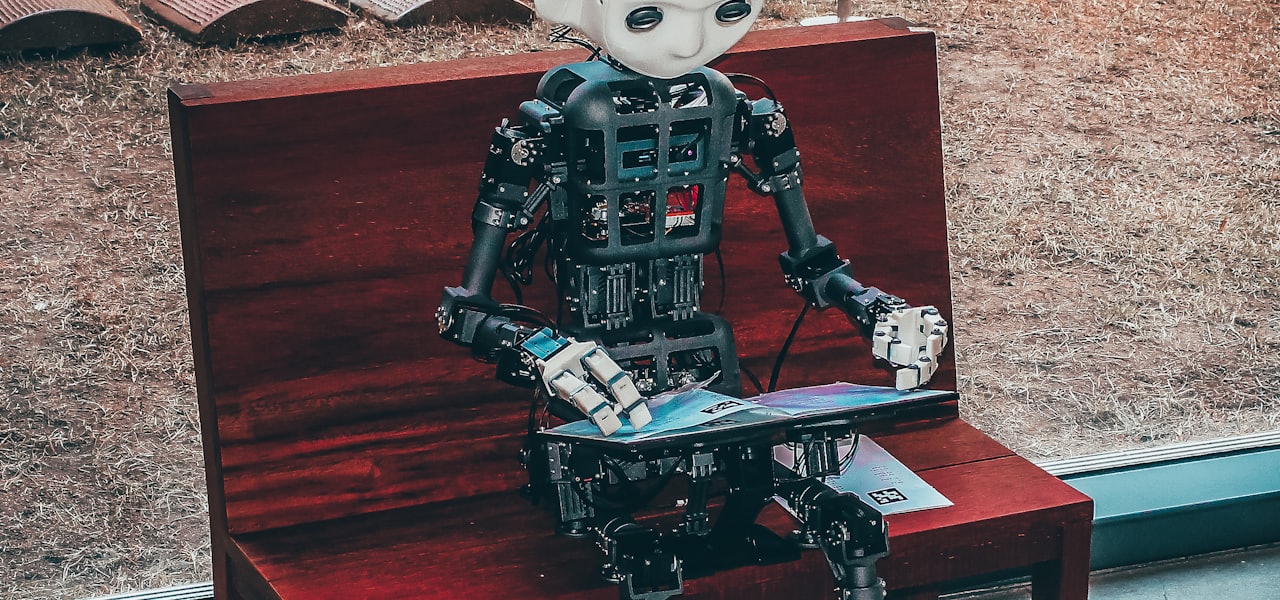
In the philosophy of artificial intelligence, GOFAI (good old-fashioned artificial intelligence) is classical symbolic AI, as opposed to other approaches, such as neural networks, situated robotics, narrow symbolic AI or neuro-symbolic AI. The term was coined by philosopher John Haugeland in his 1985 book Artificial Intelligence: The Very Idea. Haugeland coined the term to address two questions: Can GOFAI produce human-level artificial intelligence in a machine? Is GOFAI the primary method that brains use to display intelligence? AI founder Herbert A. Simon speculated in 1963 that the answers to both these questions was "yes". His evidence was the performance of programs he had co-written, such as Logic Theorist and the General Problem Solver, and his psychological research on human problem solving. AI research in the 1950s and 60s had an enormous influence on intellectual history: it inspired the cognitive revolution, led to the founding of the academic field of cognitive science, and was the essential example in the philosophical theories of computationalism, functionalism and cognitivism in ethics and the psychological theories of cognitivism and cognitive psychology. The specific aspect of AI research that led to this revolution was what Haugeland called "GOFAI". In AI development and technology, GOFAI is used to refer to programs that are built with deliberate, explicit instructions for a single task. This is in contrast to approaches that use machine learning. Examples of GOFAI applications include AlphaGo and Apple's initial Siri design. == Western rationalism == Haugeland places GOFAI within the rationalist tradition in western philosophy, which holds that abstract reason is the "highest" faculty, that it is what separates man from the animals, and that it is the most essential part of our intelligence. This assumption is present in Plato and Aristotle, in Shakespeare, Hobbes, Hume and Locke, it was central to the Enlightenment, to the logical positivists of the 1930s, and to the computationalists and cognitivists of the 1960s. As Shakespeare wrote: What a piece of work is a man, How noble in reason, how infinite in faculty ... In apprehension how like a god, The beauty of the world, The paragon of animals. Symbolic AI in the 1960s was able to successfully simulate the process of high-level reasoning, including logical deduction, algebra, geometry, spatial reasoning and means-ends analysis, all of them in precise English sentences, just like the ones humans used when they reasoned. Many observers, including philosophers, psychologists and the AI researchers themselves became convinced that they had captured the essential features of intelligence. This was not just hubris or speculation -- this was entailed by rationalism. If it was not true, then it brings into question a large part of the entire Western philosophical tradition. Continental philosophy, which included Nietzsche, Husserl, Heidegger and others, rejected rationalism and argued that our high-level reasoning was limited and prone to error, and that most of our abilities come from our intuitions, culture, and instinctive feel for the situation. Philosophers who were familiar with this tradition were the first to criticize GOFAI and the assertion that it was sufficient for intelligence, such as Hubert Dreyfus and Haugeland. == Haugeland's GOFAI == Critics and supporters of Haugeland's position, from philosophy, psychology, or AI research have found it difficult to define "GOFAI" precisely, and thus the literature contains a variety of interpretations. Drew McDermott, for example, finds Haugeland's description of GOFAI "incoherent" and argues that GOFAI is a "myth". Haugeland coined the term GOFAI in order to examine the philosophical implications of “the claims essential to all GOFAI theories”, which he listed as: 1. our ability to deal with things intelligently is due to our capacity to think about them reasonably (including sub-conscious thinking); and 2. our capacity to think about things reasonably amounts to a faculty for internal “automatic” symbol manipulation This is very similar to the sufficient side of the physical symbol systems hypothesis proposed by Herbert A. Simon and Allen Newell in 1963: "A physical symbol system has the necessary and sufficient means for general intelligent action." It is also similar to Hubert Dreyfus' "psychological assumption": "The mind can be viewed as a device operating on bits of information according to formal rules. " Haugeland's description of GOFAI refers to symbol manipulation governed by a set of instructions for manipulating the symbols. The "symbols" he refers to are discrete physical things that are assigned a definite semantics -- like
Video editing software
Video editing software or a video editor is software used for performing the post-production video editing of digital video sequences on a non-linear editing system (NLE). It has replaced traditional flatbed celluloid film editing tools and analog video tape editing machines. Video editing software serves a lot of purposes, such as filmmaking, audio commentary, and general editing of video content. In NLE software, the user manipulates sections of video, images, and audio on a sequence. These clips can be trimmed, cut, and manipulated in many different ways. When editing is finished, the user exports the sequence as a video file. == Components == === Timeline === NLE software is typically based on a timeline interface where sections moving image video recordings, known as clips, are laid out in sequence and played back. The NLE offers a range of tools for trimming, splicing, cutting, and arranging clips across the timeline. Another kind of clip is a text clip, used to add text to a video, such as title screens or movie credits. Audio clips can additionally be mixed together, such as mixing a soundtrack with multiple sound effects. Typically, the timeline is divided into multiple rows on the y-axis for different clips playing simultaneously, whereas the x-axis represents the run time of the video. Effects such as transitions can be performed on each clip, such as a crossfade effect going from one scene to another. === Exporting === Since video editors represent a project with a file format specific to the program, one needs to export the video file in order to publish it. Once a project is complete, the editor can then export to movies in a variety of formats in a context that may range from broadcast tape formats to compressed video files for web publishing (such as on an online video platform or personal website), optical media, or saved to mobile devices. To facilitate editing, source video typically has a higher resolution than the desired output. Therefore, higher resolution video needs to be downscaled during exporting, or after exporting in a process known as transsizing. === Visual effects === As digital video editing advanced, visual effects became possible, and is part of the standard toolkit, usually found in prosumer and professional grade software. A common ability is to do compositing techniques such as chroma keying or luma keying, among others, which allow different objects to look as if they are in the same scene. A different kind of visual effects is motion capture. Software such as Blender can perform motion capture to make animated objects follow an actor's movements. === Additional features === Most professional video editors are able to do color grading, which is to manipulate visual attributes of a video such as contrast to enhance output, and improve emotional impact. Some video editors such as iMovie include stock footage available for use. == Hardware requirements == As video editing puts great demands on storage and graphics performance, especially at high resolutions such as 4K, and for videos with many visual effects, powerful hardware is often required. It is not uncommon for a computer built for video editing to have a lot of drive capacity, and a powerful graphics processing unit, which optimally has hardware accelerated video encoding. Having sufficient disk space is important since videos can take up large amounts of storage, depending on the resolution and compression format used. Each minute of a Full HD (1080p) video at 30 fps takes up 60MB of space. When visual effects are used, a server farm can be employed to speed up the rendering process. == Examples == Video editing software can be divided into consumer grade, which focuses on ease-of-use, along with professional grade software, which focuses on feature availability, and advanced editing techniques. The typical use case for the former is to edit personal videos on the go, when more advanced editing is not required. === Consumer grade === Photos (Apple) Google Photos YouTube Create === Prosumer grade === ==== Proprietary software ==== iMovie CyberLink PowerDirector === Professional grade === ==== Proprietary software ==== Final Cut Pro Adobe Premiere Pro DaVinci Resolve Vegas Pro Lightworks Camtasia Media Composer ==== Free and open source software ==== Avidemux Blender Cinelerra Flowblade Kdenlive OpenShot Shotcut While most video editing software has been separate from the operating systems, some operating systems have had a video editor installed by default, such as Windows Movie Maker in Windows XP, or as a component of the default photo viewer, such as the Photos app on iOS. Some social media platforms, such as TikTok and Instagram may include a rudimentary video editor to trim clips.
Sentiment analysis
Sentiment analysis (also known as opinion mining) is the use of natural language processing, text analysis, computational linguistics, and biometrics to systematically identify, extract, quantify, and study affective states and subjective information. Sentiment analysis is widely applied to voice of the customer materials such as reviews and survey responses, online and social media, and healthcare materials for applications that range from marketing to customer service to clinical medicine. With the rise of deep language models, such as RoBERTa, more difficult data domains can be analyzed, e.g., news texts where authors typically express their opinion/sentiment less explicitly. == Types == A basic task in sentiment analysis is classifying the polarity of a given text at the document, sentence, or feature/aspect level—whether the expressed opinion in a document, a sentence or an entity feature/aspect is positive, negative, or neutral. Advanced, "beyond polarity" sentiment classification looks, for instance, at emotional states such as enjoyment, anger, disgust, sadness, fear, and surprise. Precursors to sentimental analysis include the General Inquirer, which provided hints toward quantifying patterns in text and, separately, psychological research that examined a person's psychological state based on analysis of their verbal behavior. Subsequently, the method described in a patent by Volcani and Fogel, looked specifically at sentiment and identified individual words and phrases in text with respect to different emotional scales. A current system based on their work, called EffectCheck, presents synonyms that can be used to increase or decrease the level of evoked emotion in each scale. Many other subsequent efforts were less sophisticated, using a mere polar view of sentiment, from positive to negative, such as work by Turney, and Pang who applied different methods for detecting the polarity of product reviews and movie reviews respectively. This work is at the document level. One can also classify a document's polarity on a multi-way scale, which was attempted by Pang and Snyder among others: Pang and Lee expanded the basic task of classifying a movie review as either positive or negative to predict star ratings on either a 3- or a 4-star scale, while Snyder performed an in-depth analysis of restaurant reviews, predicting ratings for various aspects of the given restaurant, such as the food and atmosphere (on a five-star scale). First steps to bringing together various approaches—learning, lexical, knowledge-based, etc.—were taken in the 2004 AAAI Spring Symposium where linguists, computer scientists, and other interested researchers first aligned interests and proposed shared tasks and benchmark data sets for the systematic computational research on affect, appeal, subjectivity, and sentiment in text. Even though in most statistical classification methods, the neutral class is ignored under the assumption that neutral texts lie near the boundary of the binary classifier, several researchers suggest that, as in every polarity problem, three categories must be identified. Moreover, it can be proven that specific classifiers such as the Max Entropy and SVMs can benefit from the introduction of a neutral class and improve the overall accuracy of the classification. There are in principle two ways for operating with a neutral class. Either, the algorithm proceeds by first identifying the neutral language, filtering it out and then assessing the rest in terms of positive and negative sentiments, or it builds a three-way classification in one step. This second approach often involves estimating a probability distribution over all categories (e.g. naive Bayes classifiers as implemented by the NLTK). Whether and how to use a neutral class depends on the nature of the data: if the data is clearly clustered into neutral, negative and positive language, it makes sense to filter the neutral language out and focus on the polarity between positive and negative sentiments. If, in contrast, the data are mostly neutral with small deviations towards positive and negative affect, this strategy would make it harder to clearly distinguish between the two poles. A different method for determining sentiment is the use of a scaling system whereby words commonly associated with having a negative, neutral, or positive sentiment are given an associated number on a −10 to +10 scale (most negative up to most positive) or simply from 0 to a positive upper limit such as +4. This makes it possible to adjust the sentiment of a given term relative to its environment (usually on the level of the sentence). When a piece of unstructured text is analyzed using natural language processing, each concept in the specified environment is given a score based on the way sentiment words relate to the concept and its associated score. This allows movement to a more sophisticated understanding of sentiment, because it is now possible to adjust the sentiment value of a concept relative to modifications that may surround it. Words, for example, that intensify, relax or negate the sentiment expressed by the concept can affect its score. Alternatively, texts can be given a positive and negative sentiment strength score if the goal is to determine the sentiment in a text rather than the overall polarity and strength of the text. There are various other types of sentiment analysis, such as aspect-based sentiment analysis, grading sentiment analysis (positive, negative, neutral), multilingual sentiment analysis and detection of emotions. === Subjectivity/objectivity identification === This task is commonly defined as classifying a given text (usually a sentence) into one of two classes: objective or subjective. This problem can sometimes be more difficult than polarity classification. The subjectivity of words and phrases may depend on their context and an objective document may contain subjective sentences (e.g., a news article quoting people's opinions). Moreover, as mentioned by Su, results are largely dependent on the definition of subjectivity used when annotating texts. However, Pang showed that removing objective sentences from a document before classifying its polarity helped improve performance. Subjective and objective identification, emerging subtasks of sentiment analysis to use syntactic, semantic features, and machine learning knowledge to identify if a sentence or document contains facts or opinions. Awareness of recognizing factual and opinions is not recent, having possibly first presented by Carbonell at Yale University in 1979. The term objective refers to the incident carrying factual information. Example of an objective sentence: 'To be elected president of the United States, a candidate must be at least thirty-five years of age.' The term subjective describes the incident contains non-factual information in various forms, such as personal opinions, judgment, and predictions, also known as 'private states'. In the example down below, it reflects a private states 'We Americans'. Moreover, the target entity commented by the opinions can take several forms from tangible product to intangible topic matters stated in Liu (2010). Furthermore, three types of attitudes were observed by Liu (2010), 1) positive opinions, 2) neutral opinions, and 3) negative opinions. Example of a subjective sentence: 'We Americans need to elect a president who is mature and who is able to make wise decisions.' This analysis is a classification problem. Each class's collections of words or phrase indicators are defined for to locate desirable patterns on unannotated text. For subjective expression, a different word list has been created. Lists of subjective indicators in words or phrases have been developed by multiple researchers in the linguist and natural language processing field states in Riloff et al. (2003). A dictionary of extraction rules has to be created for measuring given expressions. Over the years, in subjective detection, the features extraction progression from curating features by hand to automated features learning. At the moment, automated learning methods can further separate into supervised and unsupervised machine learning. Patterns extraction with machine learning process annotated and unannotated text have been explored extensively by academic researchers. However, researchers recognized several challenges in developing fixed sets of rules for expressions respectably. Much of the challenges in rule development stems from the nature of textual information. Six challenges have been recognized by several researchers: 1) metaphorical expressions, 2) discrepancies in writings, 3) context-sensitive, 4) represented words with fewer usages, 5) time-sensitive, and 6) ever-growing volume. Metaphorical expressions. The text contains metaphoric expression may impact on the performance on the extraction. Besides, metaphors take in different forms, which may have been contribu
Superincreasing sequence
In mathematics, a sequence of positive real numbers ( s 1 , s 2 , . . . ) {\displaystyle (s_{1},s_{2},...)} is called superincreasing if every element of the sequence is greater than the sum of all previous elements in the sequence. Formally, this condition can be written as s n + 1 > ∑ j = 1 n s j {\displaystyle s_{n+1}>\sum _{j=1}^{n}s_{j}} for all n ≥ 1. == Program == The following Python source code tests a sequence of numbers to determine if it is superincreasing: This produces the following output: Sum: 0 Element: 1 Sum: 1 Element: 3 Sum: 4 Element: 6 Sum: 10 Element: 13 Sum: 23 Element: 27 Sum: 50 Element: 52 Is it a superincreasing sequence? True == Examples == (1, 3, 6, 13, 27, 52) is a superincreasing sequence, but (1, 3, 4, 9, 15, 25) is not. The series a^x for a>=2 == Properties == Multiplying a superincreasing sequence by a positive real constant keeps it superincreasing.
Software token
A software token (a.k.a. soft token) is a piece of a two-factor authentication security device that may be used to authorize the use of computer services. Software tokens are stored on a general-purpose electronic device such as a desktop computer, laptop, PDA, or mobile phone and can be duplicated. (Contrast hardware tokens, where the credentials are stored on a dedicated hardware device and therefore cannot be duplicated — absent physical invasion of the device) Because software tokens are something one does not physically possess, they are exposed to unique threats based on duplication of the underlying cryptographic material - for example, computer viruses and software attacks. Both hardware and software tokens are vulnerable to bot-based man-in-the-middle attacks, or to simple phishing attacks in which the one-time password provided by the token is solicited, and then supplied to the genuine website in a timely manner. Software tokens do have benefits: there is no physical token to carry, they do not contain batteries that will run out, and they are cheaper than hardware tokens. == Security architecture == There are two primary architectures for software tokens: shared secret and public-key cryptography. For a shared secret, an administrator will typically generate a configuration file for each end-user. The file will contain a username, a personal identification number, and the secret. This configuration file is given to the user. The shared secret architecture is potentially vulnerable in a number of areas. The configuration file can be compromised if it is stolen and the token is copied. With time-based software tokens, it is possible to borrow an individual's PDA or laptop, set the clock forward, and generate codes that will be valid in the future. Any software token that uses shared secrets and stores the PIN alongside the shared secret in a software client can be stolen and subjected to offline attacks. Shared secret tokens can be difficult to distribute, since each token is essentially a different piece of software. Each user must receive a copy of the secret, which can create time constraints. Some newer software tokens rely on public-key cryptography, or asymmetric cryptography. This architecture eliminates some of the traditional weaknesses of software tokens, but does not affect their primary weakness (ability to duplicate). A PIN can be stored on a remote authentication server instead of with the token client, making a stolen software token no good unless the PIN is known as well. However, in the case of a virus infection, the cryptographic material can be duplicated and then the PIN can be captured (via keylogging or similar) the next time the user authenticates. If there are attempts made to guess the PIN, it can be detected and logged on the authentication server, which can disable the token. Using asymmetric cryptography also simplifies implementation, since the token client can generate its own key pair and exchange public keys with the server.
Exploration–exploitation dilemma
The exploration–exploitation dilemma, also known as the explore–exploit tradeoff, is a fundamental concept in decision-making that arises in many domains. It is depicted as the balancing act between two opposing strategies. Exploitation involves choosing the best option based on current knowledge of the system (which may be incomplete or misleading), while exploration involves trying out new options that may lead to better outcomes in the future at the expense of an exploitation opportunity. Finding the optimal balance between these two strategies is a crucial challenge in many decision-making problems whose goal is to maximize long-term benefits. == Application in machine learning == In the context of machine learning, the exploration–exploitation tradeoff is fundamental in reinforcement learning (RL), a type of machine learning that involves training agents to make decisions based on feedback from the environment. Crucially, this feedback may be incomplete or delayed. The agent must decide whether to exploit the current best-known policy or explore new policies to improve its performance. === Multi-armed bandit methods === The multi-armed bandit (MAB) problem was a classic example of the tradeoff, and many methods were developed for it, such as epsilon-greedy, Thompson sampling, and the upper confidence bound (UCB). See the page on MAB for details. In more complex RL situations than the MAB problem, the agent can treat each choice as a MAB, where the payoff is the expected future reward. For example, if the agent performs an epsilon-greedy method, then the agent will often "pull the best lever" by picking the action that had the best predicted expected reward (exploit). However, it would pick a random action with probability epsilon (explore). Monte Carlo tree search, for example, uses a variant of the UCB method. === Exploration problems === There are some problems that make exploration difficult. Sparse reward. If rewards occur only once a long while, then the agent might not persist in exploring. Furthermore, if the space of actions is large, then the sparse reward would mean the agent would not be guided by the reward to find a good direction for deeper exploration. A standard example is Montezuma's Revenge. Deceptive reward. If some early actions give immediate small reward, but other actions give later large reward, then the agent might be lured away from exploring the other actions. Noisy TV problem. If certain observations are irreducibly noisy (such as a television showing random images), then the agent might be trapped exploring those observations (watching the television). === Exploration reward === This section based on. The exploration reward (also called exploration bonus) methods convert the exploration-exploitation dilemma into a balance of exploitations. That is, instead of trying to get the agent to balance exploration and exploitation, exploration is simply treated as another form of exploitation, and the agent simply attempts to maximize the sum of rewards from exploration and exploitation. The exploration reward can be treated as a form of intrinsic reward. We write these as r t i , r t e {\displaystyle r_{t}^{i},r_{t}^{e}} , meaning the intrinsic and extrinsic rewards at time step t {\displaystyle t} . However, exploration reward is different from exploitation in two regards: The reward of exploitation is not freely chosen, but given by the environment, but the reward of exploration may be picked freely. Indeed, there are many different ways to design r t i {\displaystyle r_{t}^{i}} described below. The reward of exploitation is usually stationary (i.e. the same action in the same state gives the same reward), but the reward of exploration is non-stationary (i.e. the same action in the same state should give less and less reward). Count-based exploration uses N n ( s ) {\displaystyle N_{n}(s)} , the number of visits to a state s {\displaystyle s} during the time-steps 1 : n {\displaystyle 1:n} , to calculate the exploration reward. This is only possible in small and discrete state space. Density-based exploration extends count-based exploration by using a density model ρ n ( s ) {\displaystyle \rho _{n}(s)} . The idea is that, if a state has been visited, then nearby states are also partly-visited. In maximum entropy exploration, the entropy of the agent's policy π {\displaystyle \pi } is included as a term in the intrinsic reward. That is, r t i = − ∑ a π ( a | s t ) ln π ( a | s t ) + ⋯ {\displaystyle r_{t}^{i}=-\sum _{a}\pi (a|s_{t})\ln \pi (a|s_{t})+\cdots } . === Prediction-based === This section based on. The forward dynamics model is a function for predicting the next state based on the current state and the current action: f : ( s t , a t ) ↦ s t + 1 {\displaystyle f:(s_{t},a_{t})\mapsto s_{t+1}} . The forward dynamics model is trained as the agent plays. The model becomes better at predicting state transition for state-action pairs that had been done many times. A forward dynamics model can define an exploration reward by r t i = ‖ f ( s t , a t ) − s t + 1 ‖ 2 2 {\displaystyle r_{t}^{i}=\|f(s_{t},a_{t})-s_{t+1}\|_{2}^{2}} . That is, the reward is the squared-error of the prediction compared to reality. This rewards the agent to perform state-action pairs that had not been done many times. This is however susceptible to the noisy TV problem. Dynamics model can be run in latent space. That is, r t i = ‖ f ( s t , a t ) − ϕ ( s t + 1 ) ‖ 2 2 {\displaystyle r_{t}^{i}=\|f(s_{t},a_{t})-\phi (s_{t+1})\|_{2}^{2}} for some featurizer ϕ {\displaystyle \phi } . The featurizer can be the identity function (i.e. ϕ ( x ) = x {\displaystyle \phi (x)=x} ), randomly generated, the encoder-half of a variational autoencoder, etc. A good featurizer improves forward dynamics exploration. The Intrinsic Curiosity Module (ICM) method trains simultaneously a forward dynamics model and a featurizer. The featurizer is trained by an inverse dynamics model, which is a function for predicting the current action based on the features of the current and the next state: g : ( ϕ ( s t ) , ϕ ( s t + 1 ) ) ↦ a t {\displaystyle g:(\phi (s_{t}),\phi (s_{t+1}))\mapsto a_{t}} . By optimizing the inverse dynamics, both the inverse dynamics model and the featurizer are improved. Then, the improved featurizer improves the forward dynamics model, which improves the exploration of the agent. Random Network Distillation (RND) method attempts to solve this problem by teacher–student distillation. Instead of a forward dynamics model, it has two models f , f ′ {\displaystyle f,f'} . The f ′ {\displaystyle f'} teacher model is fixed, and the f {\displaystyle f} student model is trained to minimize ‖ f ( s ) − f ′ ( s ) ‖ 2 2 {\displaystyle \|f(s)-f'(s)\|_{2}^{2}} on states s {\displaystyle s} . As a state is visited more and more, the student network becomes better at predicting the teacher. Meanwhile, the prediction error is also an exploration reward for the agent, and so the agent learns to perform actions that result in higher prediction error. Thus, we have a student network attempting to minimize the prediction error, while the agent attempting to maximize it, resulting in exploration. The states are normalized by subtracting a running average and dividing a running variance, which is necessary since the teacher model is frozen. The rewards are normalized by dividing with a running variance. Exploration by disagreement trains an ensemble of forward dynamics models, each on a random subset of all ( s t , a t , s t + 1 ) {\displaystyle (s_{t},a_{t},s_{t+1})} tuples. The exploration reward is the variance of the models' predictions. === Noise === For neural network–based agents, the NoisyNet method changes some of its neural network modules by noisy versions. That is, some network parameters are random variables from a probability distribution. The parameters of the distribution are themselves learnable. For example, in a linear layer y = W x + b {\displaystyle y=Wx+b} , both W , b {\displaystyle W,b} are sampled from Gaussian distributions N ( μ W , Σ W ) , N ( μ b , Σ b ) {\displaystyle {\mathcal {N}}(\mu _{W},\Sigma _{W}),{\mathcal {N}}(\mu _{b},\Sigma _{b})} at every step, and the parameters μ W , Σ W , μ b , Σ b {\displaystyle \mu _{W},\Sigma _{W},\mu _{b},\Sigma _{b}} are learned via the reparameterization trick.
Data proliferation
Data proliferation refers to the prodigious amount of data, structured and unstructured, that businesses and governments continue to generate at an unprecedented rate and the usability problems that result from attempting to store and manage that data. While originally pertaining to problems associated with paper documentation, data proliferation has become a major problem in primary and secondary data storage on computers. While digital storage has become cheaper, the associated costs, from raw power to maintenance and from metadata to search engines, have not kept up with the proliferation of data. Although the power required to maintain a unit of data has fallen, the cost of facilities which house the digital storage has tended to rise. Data proliferation has been documented as a problem for the U.S. military since August 1971, in particular regarding the excessive documentation submitted during the acquisition of major weapon systems. Efforts to mitigate data proliferation and the problems associated with it are ongoing. == Problems caused == The problem of data proliferation is affecting all areas of commerce as a result of the availability of relatively inexpensive data storage devices. This has made it very easy to dump data into secondary storage immediately after its window of usability has passed. This masks problem that could gravely affect the profitability of businesses and the efficient functioning of health services, police and security forces, local and national governments, and many other types of organizations. Data proliferation is problematic for several reasons: Difficulty when trying to find and retrieve information. At Xerox, on average it takes employees more than one hour per week to find hard-copy documents, costing $2,152 a year to manage and store them. For businesses with more than 10 employees, this increases to almost two hours per week at $5,760 per year. In large networks of primary and secondary data storage, problems finding electronic data are analogous to problems finding hard copy data. Data loss and legal liability when data is disorganized, not properly replicated, or cannot be found promptly. In April 2005, the Ameritrade Holding Corporation told 200,000 current and past customers that a tape containing confidential information had been lost or destroyed in transit. In May of the same year, Time Warner Incorporated reported that 40 tapes containing personal data on 600,000 current and former employees had been lost en route to a storage facility. In March 2005, a Florida judge hearing a $2.7 billion lawsuit against Morgan Stanley issued an "adverse inference order" against the company for "willful and gross abuse of its discovery obligations." The judge cited Morgan Stanley for repeatedly finding misplaced tapes of e-mail messages long after the company had claimed that it had turned over all such tapes to the court. Increased manpower requirements to manage increasingly chaotic data storage resources. Slower networks and application performance due to excess traffic as users search and search again for the material they need. High cost in terms of the energy resources required to operate storage hardware. A 100 terabyte system will cost up to $35,040 a year to run—not counting cooling costs. == Proposed solutions == Applications that better utilize modern technology Reductions in duplicate data (especially as caused by data movement) Improvement of metadata structures Improvement of file and storage transfer structures User education and discipline The implementation of Information Lifecycle Management solutions to eliminate low-value information as early as possible before putting the rest into actively managed long-term storage in which it can be quickly and cheaply accessed.