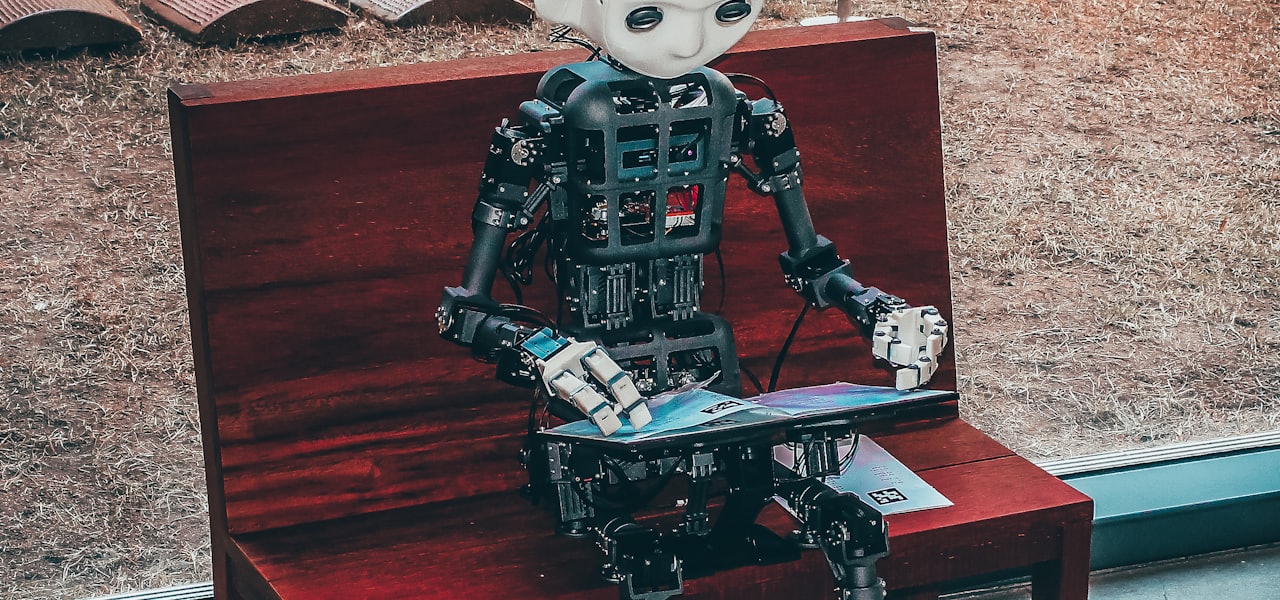
Lawbots are a broad class of customer-facing legal AI applications that are used to automate specific legal tasks, such as document automation and legal research. The terms robot lawyer and lawyer bot are used as synonyms to lawbot. A robot lawyer or a robo-lawyer refers to a legal AI application that can perform tasks that are typically done by paralegals or young associates at law firms. However, there is some debate on the correctness of the term. Some commentators say that legal AI is technically speaking neither a lawyer nor a robot and should not be referred to as such. Other commentators believe that the term can be misleading and note that the robot lawyer of the future will not be one all-encompassing application but a collection of specialized bots for various tasks. Lawbots use various artificial intelligence techniques or other intelligent systems to limit humans' direct ongoing involvement in certain steps of a legal matter. The user interfaces on lawbots vary from smart searches and step-by-step forms to chatbots. Consumer and enterprise-facing lawbot solutions often do not require direct supervision from a legal professional. Depending on the task, some client-facing solutions used at law firms operate under an attorney supervision. == Levels of autonomy == The following levels of autonomy (LoA) are suggested for automated AI legal reasoning: Level 0 (LoA0): No automation for AI legal reasoning Level 1 (LoA1): Simple assistance automation Level 2 (LoA2): Advanced assistance automation Level 3 (LoA3): Semi-autonomous automation Level 4 (LoA4): Domain automation Level 5 (LoA5): Fully-autonomous automation Level 6 (LoA6): Superhuman automation == Examples == Some legal AI solutions are developed and marketed directly to the customers or consumers, whereas other applications are tools for the attorneys at law firms. There are already hundreds of legal AI solutions that operate in multitude of ways varying in sophistication and dependence on scripted algorithms. One notable legal technology chatbot application is DoNotPay. It had started off as an app for contesting parking tickets, but has since expanded to include features that help users with many different types of legal issues, ranging from consumer protection to immigration rights and other social issues. == Impact on the legal industry == In the 2016 report, Deloitte estimated that more than 110,000 law jobs in just the United Kingdom alone could disappear within the next twenty years due to automation. This change could result in the creation of more highly skilled jobs and in the reduction of paralegal and temporary positions. Deloitte's report asserts that "there is significant potential for high-skilled roles that involve repetitive processes to be automated by smart and self-learning algorithms". According to Lawyers to Engage, between 22% of a lawyer’s work and 35% of a legal assistant’s work can be automated in the US. Top law schools like Harvard have already begun to integrate Artificial Intelligence into the curriculum. Legal tech start-up companies have begun developing applications that assist law firms with completing low-risk legal processes. These applications can enable lawyers to focus on more work that requires their specific expertise. The automation of processes like contract reviewing, enforcement of negotiations (smart contracts) and client intake (expert systems) allows law firms to streamline their procedures and improve efficiency. In addition, automation benefits small-to-medium law firms that do not have the resources to utilize junior talent on such routine tasks. The increase of law firms utilizing automated applications could result into legal tech becoming a necessity in the industry. Digital Reason CEO, Tim Estes, stated that those who refuse the opportunity to integrate AI in their workflow are “most at risk.” In 2018, Forbes reported a 713% increase in investments in legal tech. This rapid growth is reflective of law firms beginning to “cede business to… new model legal providers… that meld technological, business and legal expertise.” == Access to law and justice == It has been widely estimated for at least the last generation that all the programs and resources devoted to ensuring access to justice address only 20% of the civil legal needs of low-income people in the United States. Drawing on this experience, in late 2011, the U.S. government-funded Legal Services Corporation decided to convene a summit of leaders to explore how best to use technology in the access-to-justice community. The group adopted a mission for The Summit on the Use of Technology to Expand Access to Justice (Summit) consistent with the magnitude of the challenge: "to explore the potential of technology to move the United States toward providing some form of effective assistance to 100% of persons otherwise unable to afford an attorney for dealing with essential civil legal needs". In April 2017, joined by Microsoft and Pro Bono Net, the Legal Services Corporation (LSC) announced a pilot program to develop online, statewide legal portals to direct individuals with civil legal needs to the most appropriate forms of assistance. == Technological limitations == Current research in subjects such as computational privacy, explainable machine learning, Bayesian deep learning, knowledge-intensive machine learning, and transfer learning reveals that we do not yet have the technology to enable Level 4 to 6 AI lawbots. In 2023, OpenLaw began developing a model called Law Bot, which interacts in a conversational way as an attorney. The dialogue format makes it possible for Law Bot to answer follow-up questions, challenge incorrect premises, and reject inappropriate requests. Currently, they try to ensure it is in full compliance with all laws and regulations while conducting further beta testing before releasing it to the general public.
Algorithmic bias
Algorithmic bias describes systematic and repeatable harmful tendency in a computerized sociotechnical system to create "unfair" outcomes, such as "privileging" one category over another in ways that may or may not be different from the intended function of the algorithm. Bias can emerge from many factors, including intentionally biased design decisions or the unintended or unanticipated use or decisions relating to the way data is coded, collected, selected or used to train the algorithm. For example, algorithmic bias has been observed in search engine results and social media platforms. This bias can have impacts ranging from privacy violations to reinforcing social biases of race, gender, sexuality, and ethnicity. The study of algorithmic bias is most concerned with algorithms that reflect "systematic and unfair" discrimination. This bias has only recently been addressed in legal frameworks, such as the European Union's General Data Protection Regulation (enforced in 2018) and the Artificial Intelligence Act (proposed in 2021 and adopted in 2024). As algorithms expand their ability to organize society, politics, institutions, and behavior, sociologists have become concerned with the ways in which unanticipated output and manipulation of data can impact the physical world. Because algorithms are often considered to be neutral and unbiased, they can inaccurately project greater authority than human expertise (in part due to the psychological phenomenon of automation bias), and in some cases, reliance on algorithms can displace human responsibility for their outcomes, without last mile thinking. Bias can enter into algorithmic systems as a result of pre-existing cultural, social, or institutional expectations; by how features and labels are chosen; because of technical limitations of their design; or by being used in unanticipated contexts or by audiences who are not considered in the software's initial design. Algorithmic bias has been cited in cases ranging from election outcomes to the spread of online hate speech. It has also arisen in criminal justice, healthcare, and hiring, compounding existing racial, socioeconomic, and gender biases. The relative inability of facial recognition technology to accurately identify darker-skinned faces has been linked to multiple wrongful arrests of black men, an issue stemming from imbalanced datasets. Problems in understanding, researching, and discovering algorithmic bias persist due to the proprietary nature of algorithms, which are typically treated as trade secrets. Even when full transparency is provided, the complexity of certain algorithms poses a barrier to understanding their functioning. Furthermore, algorithms may change, or respond to input or output in ways that cannot be anticipated or easily reproduced for analysis. In many cases, even within a single website or application, there is no single "algorithm" to examine, but a network of many interrelated programs and data inputs, even between users of the same service. A 2021 survey identified multiple forms of algorithmic bias, including historical, representation, and measurement biases, each of which can contribute to unfair outcomes. == Definitions == Algorithms are difficult to define, but may be generally understood as lists of instructions that determine how programs read, collect, process, and analyze data to generate a usable output. For a rigorous technical introduction, see Algorithms. Advances in computer hardware and software have led to an increased capability to process, store and transmit data. This has in turn made the design and adoption of technologies such as machine learning and artificial intelligence technically and commercially feasible. By analyzing and processing data, algorithms are the backbone of search engines, social media websites, recommendation engines, online retail, online advertising, and more. Contemporary social scientists are concerned with algorithmic processes embedded into hardware and software applications because of their political and social impact, and question the underlying assumptions of an algorithm's neutrality. The term algorithmic bias describes systematic and repeatable errors that create unfair outcomes, such as privileging one arbitrary group of users over others. For example, a credit score algorithm may deny a loan without being unfair, if it is consistently weighing relevant financial criteria. If the algorithm recommends loans to one group of users, but denies loans to another set of nearly identical users based on unrelated criteria, and if this behavior can be repeated across multiple occurrences, an algorithm can be described as biased. This bias may be intentional or unintentional (for example, it can come from biased data obtained from a worker that previously did the job the algorithm is going to do from now on). == Methods == Bias can be introduced to an algorithm in several ways. During the assemblage of a dataset, data may be collected, digitized, adapted, and entered into a database according to human-designed cataloging criteria. Next, programmers assign priorities, or hierarchies, for how a program assesses and sorts that data. This requires human decisions about how data is categorized, and which data is included or discarded. Some algorithms collect their own data based on human-selected criteria, which can also reflect the bias of human designers. Other algorithms may reinforce stereotypes and preferences as they process and display "relevant" data for human users, for example, by selecting information based on previous choices of a similar user or group of users. Beyond assembling and processing data, bias can emerge as a result of design. For example, algorithms that determine the allocation of resources or scrutiny (such as determining school placements) may inadvertently discriminate against a category when determining risk based on similar users (as in credit scores). Meanwhile, recommendation engines that work by associating users with similar users, or that make use of inferred marketing traits, might rely on inaccurate associations that reflect broad ethnic, gender, socio-economic, or racial stereotypes. Another example comes from determining criteria for what is included and excluded from results. These criteria could present unanticipated outcomes for search results, such as with flight-recommendation software that omits flights that do not follow the sponsoring airline's flight paths. Algorithms may also display an uncertainty bias, offering more confident assessments when larger data sets are available. This can skew algorithmic processes toward results that more closely correspond with larger samples, which may disregard data from underrepresented populations. == History == === Early critiques === The earliest computer programs were designed to mimic human reasoning and deductions, and were deemed to be functioning when they successfully and consistently reproduced that human logic. In his 1976 book Computer Power and Human Reason, artificial intelligence pioneer Joseph Weizenbaum suggested that bias could arise both from the data used in a program, but also from the way a program is coded. Weizenbaum wrote that programs are a sequence of rules created by humans for a computer to follow. By following those rules consistently, such programs "embody law", that is, enforce a specific way to solve problems. The rules a computer follows are based on the assumptions of a computer programmer for how these problems might be solved. That means the code could incorporate the programmer's imagination of how the world works, including their biases and expectations. While a computer program can incorporate bias in this way, Weizenbaum also noted that any data fed to a machine additionally reflects "human decision making processes" as data is being selected. Finally, he noted that machines might also transfer good information with unintended consequences if users are unclear about how to interpret the results. Weizenbaum warned against trusting decisions made by computer programs that a user doesn't understand, comparing such faith to a tourist who can find his way to a hotel room exclusively by turning left or right on a coin toss. Crucially, the tourist has no basis of understanding how or why he arrived at his destination, and a successful arrival does not mean the process is accurate or reliable. An early example of algorithmic bias resulted in as many as 60 women and ethnic minorities denied entry to St. George's Hospital Medical School per year from 1982 to 1986, based on implementation of a new computer-guidance assessment system that denied entry to women and men with "foreign-sounding names" based on historical trends in admissions. While many schools at the time employed similar biases in their selection process, St. George was most notable for automating said bias through the use of an algorithm, thus gaining the attention of people on a much
Data annotation
Data annotation is the process of labeling or tagging relevant metadata within a dataset to enable machines to interpret the data accurately. The dataset can take various forms, including images, audio files, video footage, or text. == Applications == Data is a fundamental component in the development of artificial intelligence (AI). Training AI models, particularly in computer vision and natural language processing, requires large volumes of annotated data. Proper annotation ensures that machine learning algorithms can recognize patterns and make accurate predictions. Common types of data annotation include classification, bounding boxes, semantic segmentation, and keypoint annotation. Data annotation is used in AI-driven fields, including healthcare, autonomous vehicles, retail, security, and entertainment. By accurately labeling data, machine learning models can perform complex tasks such as object detection, sentiment analysis, and speech recognition with greater precision. This growing demand has led to the emergence of specialized sectors and platforms dedicated to AI training and human-in-the-loop workflows, which often utilize Reinforcement Learning from Human Feedback (RLHF) to refine model behavior. == In computer vision == === Image classification === Image classification, also known as image categorization, involves assigning predefined labels to images. Machine learning algorithms trained on classified images can later recognize objects and differentiate between categories. For instance, an AI model trained to recognize furniture styles can distinguish between Georgian and Rococo armchairs. === Semantic segmentation === Semantic segmentation assigns each pixel in an image to a specific class, such as trees, vehicles, humans, or buildings. This type of annotation enables machine learning models to differentiate objects by grouping similar pixels, allowing for a detailed understanding of an image. === Bounding boxes === Bounding box annotation involves drawing rectangular boxes around objects in an image. This technique is commonly used in autonomous driving, security surveillance, and retail analytics to detect and classify objects such as pedestrians, vehicles, and products on store shelves. === 3D cuboids === 3D cuboid annotation enhances traditional bounding boxes by adding depth, enabling models to predict an object's spatial orientation, movement, and size. This method is particularly useful for autonomous vehicles and robotics, where understanding object dimensions and depth is critical. === Polygonal annotation === For objects with irregular shapes, such as curved or multi-sided items, polygonal annotation provides more precise labeling than bounding boxes. This technique is often used in applications that require detailed object recognition, such as medical imaging or aerial mapping. === Keypoint annotation === Keypoint annotation marks specific points on an object, such as facial landmarks or body joints, to enable tracking and motion analysis. This method is widely used in facial recognition, emotion detection, sports analytics, and augmented reality applications.
Inductive probability
Inductive probability attempts to give the probability of future events based on past events. It is the basis for inductive reasoning, and gives the mathematical basis for learning and the perception of patterns. It is a source of knowledge about the world. There are three sources of knowledge: inference, communication, and deduction. Communication relays information found using other methods. Deduction establishes new facts based on existing facts. Inference establishes new facts from data. Its basis is Bayes' theorem. Information describing the world is written in a language. For example, a simple mathematical language of propositions may be chosen. Sentences may be written down in this language as strings of characters. But in the computer it is possible to encode these sentences as strings of bits (1s and 0s). Then the language may be encoded so that the most commonly used sentences are the shortest. This internal language implicitly represents probabilities of statements. Occam's razor says the "simplest theory, consistent with the data is most likely to be correct". The "simplest theory" is interpreted as the representation of the theory written in this internal language. The theory with the shortest encoding in this internal language is most likely to be correct. == History == Probability and statistics was focused on probability distributions and tests of significance. Probability was formal, well defined, but limited in scope. In particular its application was limited to situations that could be defined as an experiment or trial, with a well defined population. Bayes's theorem is named after Rev. Thomas Bayes 1701–1761. Bayesian inference broadened the application of probability to many situations where a population was not well defined. But Bayes' theorem always depended on prior probabilities, to generate new probabilities. It was unclear where these prior probabilities should come from. Ray Solomonoff developed algorithmic probability which gave an explanation for what randomness is and how patterns in the data may be represented by computer programs, that give shorter representations of the data circa 1964. Chris Wallace and D. M. Boulton developed minimum message length circa 1968. Later Jorma Rissanen developed the minimum description length circa 1978. These methods allow information theory to be related to probability, in a way that can be compared to the application of Bayes' theorem, but which give a source and explanation for the role of prior probabilities. Marcus Hutter combined decision theory with the work of Ray Solomonoff and Andrey Kolmogorov to give a theory for the Pareto optimal behavior for an Intelligent agent, circa 1998. === Minimum description/message length === The program with the shortest length that matches the data is the most likely to predict future data. This is the thesis behind the minimum message length and minimum description length methods. At first sight Bayes' theorem appears different from the minimimum message/description length principle. At closer inspection it turns out to be the same. Bayes' theorem is about conditional probabilities, and states the probability that event B happens if firstly event A happens: P ( A ∧ B ) = P ( B ) ⋅ P ( A | B ) = P ( A ) ⋅ P ( B | A ) {\displaystyle P(A\land B)=P(B)\cdot P(A|B)=P(A)\cdot P(B|A)} becomes in terms of message length L, L ( A ∧ B ) = L ( B ) + L ( A | B ) = L ( A ) + L ( B | A ) . {\displaystyle L(A\land B)=L(B)+L(A|B)=L(A)+L(B|A).} This means that if all the information is given describing an event then the length of the information may be used to give the raw probability of the event. So if the information describing the occurrence of A is given, along with the information describing B given A, then all the information describing A and B has been given. ==== Overfitting ==== Overfitting occurs when the model matches the random noise and not the pattern in the data. For example, take the situation where a curve is fitted to a set of points. If a polynomial with many terms is fitted then it can more closely represent the data. Then the fit will be better, and the information needed to describe the deviations from the fitted curve will be smaller. Smaller information length means higher probability. However, the information needed to describe the curve must also be considered. The total information for a curve with many terms may be greater than for a curve with fewer terms, that has not as good a fit, but needs less information to describe the polynomial. === Inference based on program complexity === Solomonoff's theory of inductive inference is also inductive inference. A bit string x is observed. Then consider all programs that generate strings starting with x. Cast in the form of inductive inference, the programs are theories that imply the observation of the bit string x. The method used here to give probabilities for inductive inference is based on Solomonoff's theory of inductive inference. ==== Detecting patterns in the data ==== If all the bits are 1, then people infer that there is a bias in the coin and that it is more likely also that the next bit is 1 also. This is described as learning from, or detecting a pattern in the data. Such a pattern may be represented by a computer program. A short computer program may be written that produces a series of bits which are all 1. If the length of the program K is L ( K ) {\displaystyle L(K)} bits then its prior probability is, P ( K ) = 2 − L ( K ) {\displaystyle P(K)=2^{-L(K)}} The length of the shortest program that represents the string of bits is called the Kolmogorov complexity. Kolmogorov complexity is not computable. This is related to the halting problem. When searching for the shortest program some programs may go into an infinite loop. ==== Considering all theories ==== The Greek philosopher Epicurus is quoted as saying "If more than one theory is consistent with the observations, keep all theories". As in a crime novel all theories must be considered in determining the likely murderer, so with inductive probability all programs must be considered in determining the likely future bits arising from the stream of bits. Programs that are already longer than n have no predictive power. The raw (or prior) probability that the pattern of bits is random (has no pattern) is 2 − n {\displaystyle 2^{-n}} . Each program that produces the sequence of bits, but is shorter than the n is a theory/pattern about the bits with a probability of 2 − k {\displaystyle 2^{-k}} where k is the length of the program. The probability of receiving a sequence of bits y after receiving a series of bits x is then the conditional probability of receiving y given x, which is the probability of x with y appended, divided by the probability of x. ==== Universal priors ==== The programming language affects the predictions of the next bit in the string. The language acts as a prior probability. This is particularly a problem where the programming language codes for numbers and other data types. Intuitively we think that 0 and 1 are simple numbers, and that prime numbers are somehow more complex than numbers that may be composite. Using the Kolmogorov complexity gives an unbiased estimate (a universal prior) of the prior probability of a number. As a thought experiment an intelligent agent may be fitted with a data input device giving a series of numbers, after applying some transformation function to the raw numbers. Another agent might have the same input device with a different transformation function. The agents do not see or know about these transformation functions. Then there appears no rational basis for preferring one function over another. A universal prior insures that although two agents may have different initial probability distributions for the data input, the difference will be bounded by a constant. So universal priors do not eliminate an initial bias, but they reduce and limit it. Whenever we describe an event in a language, either using a natural language or other, the language has encoded in it our prior expectations. So some reliance on prior probabilities are inevitable. A problem arises where an intelligent agent's prior expectations interact with the environment to form a self reinforcing feed back loop. This is the problem of bias or prejudice. Universal priors reduce but do not eliminate this problem. === Universal artificial intelligence === The theory of universal artificial intelligence applies decision theory to inductive probabilities. The theory shows how the best actions to optimize a reward function may be chosen. The result is a theoretical model of intelligence. It is a fundamental theory of intelligence, which optimizes the agents behavior in, Exploring the environment; performing actions to get responses that broaden the agents knowledge. Competing or co-operating with another agent; games. Balancing short and long term rewards. In general no agent will always provi
Hello World: How to be Human in the Age of the Machine
Hello World: How to Be Human in the Age of the Machine (also titled Hello World: Being Human in the Age of Algorithms) is a book on the growing influence of algorithms and artificial intelligence (AI) on human life, authored by mathematician and science communicator Hannah Fry. The book examines how algorithms are increasingly shaping decisions in critical areas such as healthcare, transportation, justice, finance, and the arts. == Overview == Fry uses real-world examples, such as driverless cars and predictive policing, to illustrate her points. She emphasizes that algorithms are not inherently objective; they reflect biases embedded in their design and data inputs. While acknowledging their potential to improve efficiency and accuracy, Fry cautions against over-reliance on machines without human judgment. Fry explores moral questions surrounding algorithmic decision-making, such as whether machines can replace human empathy in critical situations. She advocates for greater scrutiny of algorithms to ensure fairness and avoid harmful biases. The book proposes a "cyborg future", where humans work alongside algorithms to enhance decision-making while retaining ultimate control. == Reception == Hello World has been praised for its clarity, engaging storytelling, and balanced perspective. Critics have highlighted Fry's ability to make complex topics accessible to general audiences while raising important questions about technology's impact on society. The book was shortlisted for awards such as the 2018 Baillie Gifford Prize and the Royal Society Science Book Prize.
Free boundary condition
In image processing, the free boundary condition is the convention used when applying a convolution kernel to a digital image in which pixel locations that lie outside the image boundaries are interpreted as having a value of zero.[1] The question of what value to assign out-of-bounds pixels may arise, for instance, when applying a 3×3 kernel to the corner pixel in an image.
Algorithmic inference
Algorithmic inference gathers new developments in the statistical inference methods made feasible by the powerful computing devices widely available to any data analyst. Cornerstones in this field are computational learning theory, granular computing, bioinformatics, and, long ago, structural probability (Fraser 1966). The main focus is on the algorithms which compute statistics rooting the study of a random phenomenon, along with the amount of data they must feed on to produce reliable results. This shifts the interest of mathematicians from the study of the distribution laws to the functional properties of the statistics, and the interest of computer scientists from the algorithms for processing data to the information they process. == The Fisher parametric inference problem == Concerning the identification of the parameters of a distribution law, the mature reader may recall lengthy disputes in the mid 20th century about the interpretation of their variability in terms of fiducial distribution (Fisher 1956), structural probabilities (Fraser 1966), priors/posteriors (Ramsey 1925), and so on. From an epistemology viewpoint, this entailed a companion dispute as to the nature of probability: is it a physical feature of phenomena to be described through random variables or a way of synthesizing data about a phenomenon? Opting for the latter, Fisher defines a fiducial distribution law of parameters of a given random variable that he deduces from a sample of its specifications. With this law he computes, for instance "the probability that μ (mean of a Gaussian variable – omeur note) is less than any assigned value, or the probability that it lies between any assigned values, or, in short, its probability distribution, in the light of the sample observed". == The classic solution == Fisher fought hard to defend the difference and superiority of his notion of parameter distribution in comparison to analogous notions, such as Bayes' posterior distribution, Fraser's constructive probability and Neyman's confidence intervals. For half a century, Neyman's confidence intervals won out for all practical purposes, crediting the phenomenological nature of probability. With this perspective, when you deal with a Gaussian variable, its mean μ is fixed by the physical features of the phenomenon you are observing, where the observations are random operators, hence the observed values are specifications of a random sample. Because of their randomness, you may compute from the sample specific intervals containing the fixed μ with a given probability that you denote confidence. === Example === Let X be a Gaussian variable with parameters μ {\displaystyle \mu } and σ 2 {\displaystyle \sigma ^{2}} and { X 1 , … , X m } {\displaystyle \{X_{1},\ldots ,X_{m}\}} a sample drawn from it. Working with statistics S μ = ∑ i = 1 m X i {\displaystyle S_{\mu }=\sum _{i=1}^{m}X_{i}} and S σ 2 = ∑ i = 1 m ( X i − X ¯ ) 2 , where X ¯ = S μ m {\displaystyle S_{\sigma ^{2}}=\sum _{i=1}^{m}(X_{i}-{\overline {X}})^{2},{\text{ where }}{\overline {X}}={\frac {S_{\mu }}{m}}} is the sample mean, we recognize that T = S μ − m μ S σ 2 m − 1 m = X ¯ − μ S σ 2 / ( m ( m − 1 ) ) {\displaystyle T={\frac {S_{\mu }-m\mu }{\sqrt {S_{\sigma ^{2}}}}}{\sqrt {\frac {m-1}{m}}}={\frac {{\overline {X}}-\mu }{\sqrt {S_{\sigma ^{2}}/(m(m-1))}}}} follows a Student's t distribution (Wilks 1962) with parameter (degrees of freedom) m − 1, so that f T ( t ) = Γ ( m / 2 ) Γ ( ( m − 1 ) / 2 ) 1 π ( m − 1 ) ( 1 + t 2 m − 1 ) m / 2 . {\displaystyle f_{T}(t)={\frac {\Gamma (m/2)}{\Gamma ((m-1)/2)}}{\frac {1}{\sqrt {\pi (m-1)}}}\left(1+{\frac {t^{2}}{m-1}}\right)^{m/2}.} Gauging T between two quantiles and inverting its expression as a function of μ {\displaystyle \mu } you obtain confidence intervals for μ {\displaystyle \mu } . With the sample specification: x = { 7.14 , 6.3 , 3.9 , 6.46 , 0.2 , 2.94 , 4.14 , 4.69 , 6.02 , 1.58 } {\displaystyle \mathbf {x} =\{7.14,6.3,3.9,6.46,0.2,2.94,4.14,4.69,6.02,1.58\}} having size m = 10, you compute the statistics s μ = 43.37 {\displaystyle s_{\mu }=43.37} and s σ 2 = 46.07 {\displaystyle s_{\sigma ^{2}}=46.07} , and obtain a 0.90 confidence interval for μ {\displaystyle \mu } with extremes (3.03, 5.65). == Inferring functions with the help of a computer == From a modeling perspective the entire dispute looks like a chicken-egg dilemma: either fixed data by first and probability distribution of their properties as a consequence, or fixed properties by first and probability distribution of the observed data as a corollary. The classic solution has one benefit and one drawback. The former was appreciated particularly back when people still did computations with sheet and pencil. Per se, the task of computing a Neyman confidence interval for the fixed parameter θ is hard: you do not know θ, but you look for disposing around it an interval with a possibly very low probability of failing. The analytical solution is allowed for a very limited number of theoretical cases. Vice versa a large variety of instances may be quickly solved in an approximate way via the central limit theorem in terms of confidence interval around a Gaussian distribution – that's the benefit. The drawback is that the central limit theorem is applicable when the sample size is sufficiently large. Therefore, it is less and less applicable with the sample involved in modern inference instances. The fault is not in the sample size on its own part. Rather, this size is not sufficiently large because of the complexity of the inference problem. With the availability of large computing facilities, scientists refocused from isolated parameters inference to complex functions inference, i.e. re sets of highly nested parameters identifying functions. In these cases we speak about learning of functions (in terms for instance of regression, neuro-fuzzy system or computational learning) on the basis of highly informative samples. A first effect of having a complex structure linking data is the reduction of the number of sample degrees of freedom, i.e. the burning of a part of sample points, so that the effective sample size to be considered in the central limit theorem is too small. Focusing on the sample size ensuring a limited learning error with a given confidence level, the consequence is that the lower bound on this size grows with complexity indices such as VC dimension or detail of a class to which the function we want to learn belongs. === Example === A sample of 1,000 independent bits is enough to ensure an absolute error of at most 0.081 on the estimation of the parameter p of the underlying Bernoulli variable with a confidence of at least 0.99. The same size cannot guarantee a threshold less than 0.088 with the same confidence 0.99 when the error is identified with the probability that a 20-year-old man living in New York does not fit the ranges of height, weight and waistline observed on 1,000 Big Apple inhabitants. The accuracy shortage occurs because both the VC dimension and the detail of the class of parallelepipeds, among which the one observed from the 1,000 inhabitants' ranges falls, are equal to 6. == The general inversion problem solving the Fisher question == With insufficiently large samples, the approach: fixed sample – random properties suggests inference procedures in three steps: === Definition === For a random variable and a sample drawn from it a compatible distribution is a distribution having the same sampling mechanism M X = ( Z , g θ ) {\displaystyle {\mathcal {M}}_{X}=(Z,g_{\boldsymbol {\theta }})} of X with a value θ {\displaystyle {\boldsymbol {\theta }}} of the random parameter Θ {\displaystyle \mathbf {\Theta } } derived from a master equation rooted on a well-behaved statistic s. === Example === You may find the distribution law of the Pareto parameters A and K as an implementation example of the population bootstrap method as in the figure on the left. Implementing the twisting argument method, you get the distribution law F M ( μ ) {\displaystyle F_{M}(\mu )} of the mean M of a Gaussian variable X on the basis of the statistic s M = ∑ i = 1 m x i {\textstyle s_{M}=\sum _{i=1}^{m}x_{i}} when Σ 2 {\displaystyle \Sigma ^{2}} is known to be equal to σ 2 {\displaystyle \sigma ^{2}} (Apolloni, Malchiodi & Gaito 2006). Its expression is: F M ( μ ) = Φ ( m μ − s M σ m ) , {\displaystyle F_{M}(\mu )=\Phi {\left({\frac {m\mu -s_{M}}{\sigma {\sqrt {m}}}}\right)},} shown in the figure on the right, where Φ {\displaystyle \Phi } is the cumulative distribution function of a standard normal distribution. Computing a confidence interval for M given its distribution function is straightforward: we need only find two quantiles (for instance δ / 2 {\displaystyle \delta /2} and 1 − δ / 2 {\displaystyle 1-\delta /2} quantiles in case we are interested in a confidence interval of level δ symmetric in the tail's probabilities) as indicated on the left in the diagram showing the behavior of