AFNLP (Asian Federation of Natural Language Processing Associations) is the organization for coordinating the natural language processing related activities and events in the Asia-Pacific region. == Foundation == AFNLP was founded on 4 October 2000. == Member Associations == ALTA – Australasian Language Technology Association ANLP Japan Association of Natural Language Processing ROCLING Taiwan ROC Computational Linguistics Society SIG-KLC Korea SIG-Korean Language Computing of Korea Information Science Society == Existing Asian Initiatives == NLPRS: Natural Language Processing Pacific Rim Symposium IRAL: International Workshop on Information Retrieval with Asian Languages PACLING: Pacific Association for Computational Linguistics PACLIC: Pacific Asia Conference on Language, Information and Computation PRICAI: Pacific Rim International Conference on AI ICCPOL: International Conference on Computer Processing of Oriental Languages ROCLING: Research on Computational Linguistics Conference == Conferences == IJCNLP-04: The 1st International Joint Conference on Natural Language Processing in Hainan Island, China IJCNLP-05: The 2nd International Joint Conference on Natural Language Processing in Jeju Island, Korea IJCNLP-08: The 3rd International Joint Conference on Natural Language Processing in Hyderabad, India ACL-IJCNLP-2009: Joint Conference of the 47th Annual Meeting of the Association for Computational Linguistics (ACL) and 4th International Joint Conference on Natural Language Processing (IJCNLP) in Singapore IJNCLP-11: The 5th International Joint Conference on Natural Language Processing in Chiang Mai, Thailand
Amaq News Agency
Amaq News Agency (Arabic: وكالة أعماق الإخبارية, romanized: Wakālat Aʻmāq al-Ikhbārīyah) is a news outlet linked to the Islamic State (IS). Amaq is often the "first point of publication for claims of responsibility" for terrorist attacks in Western countries by the Islamic State. In March 2019, Amaq News Agency was designated as a foreign terrorist organization by the United States Department of State. == History == Among the founders of Amaq was Syrian journalist Baraa Kadek, who joined IS in late 2013, Abu Muhammad al-Furqan, and seven others who originally worked for Halab News Network. According to The New York Times, it has a direct connection with IS, from which it "gets tips". Its name was taken from Amik Valley in Hatay Province, which is mentioned in a hadith as the site of an "apocalyptic victory over non-believers". Amaq News Agency was first noticed by SITE during the Siege of Kobanî (Syria) in 2014, when its updates were shared among IS fighters. It became more widely known after it began reporting claims of responsibility for terrorist attacks in Western countries, such as the 2015 San Bernardino attack, for which IS officially claimed responsibility the next day. An Amaq cameraman shot the first footage of the capture of Palmyra in 2015. Amaq launched an official mobile app in 2015 and has warned against unofficial versions that reportedly have been used to spy on its users. It also uses a Telegram account. It had a WordPress-based blog, but it was removed without explanation in April 2016. On 12 June 2016, IS claimed responsibility for the Pulse nightclub shooting through Amaq, without prior knowledge of the attack. The shooter, Omar Mateen had later pledged allegiance to IS via a phone call with emergency services. On 31 May 2017, a Facebook post announced Amaq's founder, Baraa Kadek AKA Rayan Meshaal, had been killed with his daughter by an American airstrike on Mayadin. The post was reportedly made by his younger brother. Reuters could not immediately verify this account. On 27 July 2017, the US confirmed that Kadek had been killed by a coalition airstrike near Mayadin between 25 and 27 May 2017. In June 2017, German police arrested a 23-year-old Syrian man identified only as Mohammed G., accusing him of communicating with the alleged perpetrator of the 2016 Malmö Muslim community centre arson in order to report to Amaq. On 21 March 2019, the U.S. Department of State officially deemed Amaq an alias of IS, and thus a Foreign Terrorist Organization. On 22 March 2024, the Islamic State claimed responsibility for the Crocus City Hall attack through Amaq, U.S. officials confirmed the claim shortly after. A day after the attack, Amaq published a video of the attack, filmed by one of the attackers. It showed the attackers shooting victims and slitting the throat of another, while the filming attacker praises Allah and speaks against infidels. == Character == Amaq publishes a stream of short news reports, both text and video, on the mobile app Telegram. The reports take on the trappings of mainstream journalism, with "Breaking News" headings, and embedded reporters at the scenes of IS battles. The reports try to appear neutral, toning down the jihadist language and sectarian slurs IS uses in its official releases. Charlie Winter of the Transcultural Conflict and Violence Initiative at Georgia State University, and Rita Katz of SITE Intelligence Group in Washington say Amaq functions much like the state-owned news agency of IS, though the group does not acknowledge it as such. Katz said it behaves "like a state media". Amaq appears to have been allowed to develop by IS as a way to have a news outlet that is controlled by the group but is somewhat removed from it, giving IS more of the appearance of legitimacy. == Reliability == According to Rukmini Callimachi in The New York Times: "Despite a widespread view that the Islamic State opportunistically claims attacks with which it has little genuine connection, its track record—minus a handful of exceptions—suggests a more rigorous protocol. At times, the Islamic State has got details wrong, or inflated casualty figures, but the gist of its claims is typically correct." According to Callimachi, the group considers itself responsible for acts carried out by people who were inspired by its propaganda, as well as acts carried out by its own personnel and in some instances, had claimed attacks before the identities of the killers were known. Graeme Wood writing in The Atlantic in October 2017, wrote "The idea that the Islamic State simply scans the news in search of mass killings, then sends out press releases in hope of stealing glory, is false. Amaq may learn details of the attacks from mainstream media ... but its claim of credit typically flows from an Amaq-specific source." An October 2017 article in The Hill, points to two false claims made in the summer of 2017, the Resorts World Manila attack and a false claim that bombs had been planted at Charles de Gaulle Airport in Paris. Also, a claimed IS connection to the 2017 Las Vegas shooting proved to be false. According to Rita Katz on the SITE Intelligence Group website, calling a terrorist a "soldier of the caliphate (warrior from the caliphate)" in a statement issued by Amaq, was the usual way in which IS indicated that it inspired an attack. Centrally coordinated attacks were usually described as "executed by a detachment belonging to the Islamic State", and were often announced by both Amaq and by IS' central media command. == Online presence == In November 2019, Belgian police said they had carried out a successful cyberattack on Amaq, thus leaving IS without an operational communication channel. However, Amaq has since regained online presence, primarily on dark web platforms to make it harder for law enforcement to take them down without physical access to the server hosting the specific platform.
Robot learning
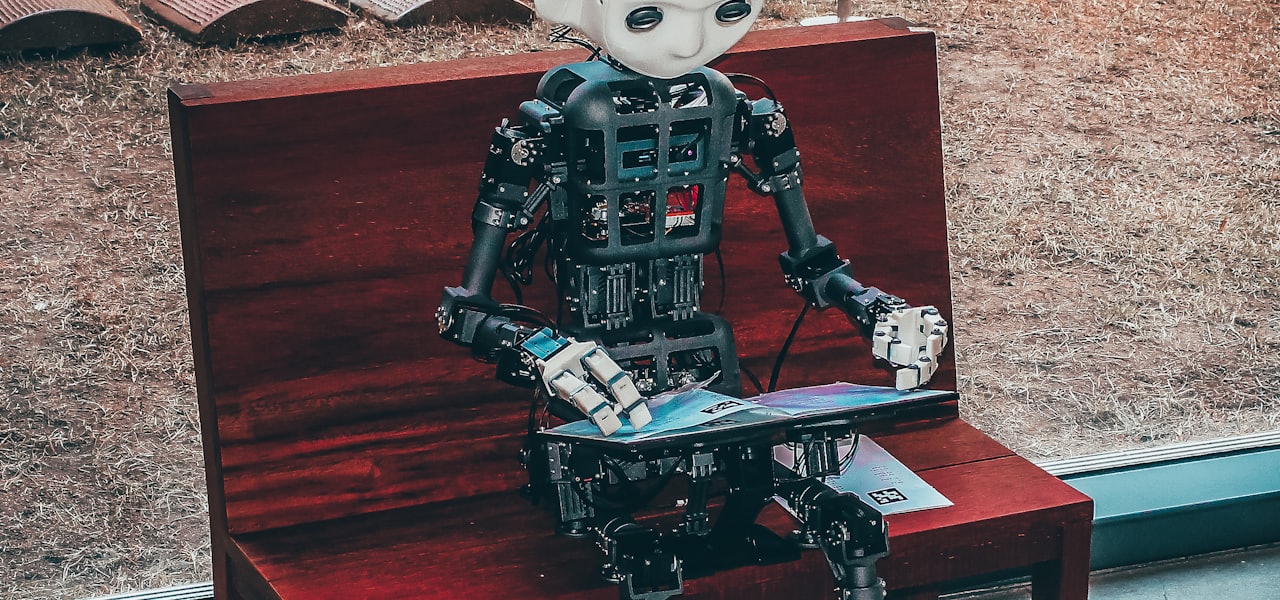
Robot learning is a research field at the intersection of machine learning and robotics. It studies techniques allowing a robot to acquire novel skills or adapt to its environment through learning algorithms. The embodiment of the robot, situated in a physical embedding, provides at the same time specific difficulties (e.g. high-dimensionality, real time constraints for collecting data and learning) and opportunities for guiding the learning process (e.g. sensorimotor synergies, motor primitives). Example of skills that are targeted by learning algorithms include sensorimotor skills such as locomotion, grasping, active object categorization, as well as interactive skills such as joint manipulation of an object with a human peer, and linguistic skills such as the grounded and situated meaning of human language. Learning can happen either through autonomous self-exploration or through guidance from a human teacher, like for example in robot learning by imitation. Robot learning can be closely related to adaptive control, reinforcement learning as well as developmental robotics which considers the problem of autonomous lifelong acquisition of repertoires of skills. While machine learning is frequently used by computer vision algorithms employed in the context of robotics, these applications are usually not referred to as "robot learning". == Imitation learning == Many research groups are developing techniques where robots learn by imitating. This includes various techniques for learning from demonstration (sometimes also referred to as "programming by demonstration") and observational learning. == Sharing learned skills and knowledge == In Tellex's "Million Object Challenge", the goal is robots that learn how to spot and handle simple items and upload their data to the cloud to allow other robots to analyze and use the information. RoboBrain is a knowledge engine for robots which can be freely accessed by any device wishing to carry out a task. The database gathers new information about tasks as robots perform them, by searching the Internet, interpreting natural language text, images, and videos, object recognition as well as interaction. The project is led by Ashutosh Saxena at Stanford University. RoboEarth is a project that has been described as a "World Wide Web for robots" − it is a network and database repository where robots can share information and learn from each other and a cloud for outsourcing heavy computation tasks. The project brings together researchers from five major universities in Germany, the Netherlands and Spain and is backed by the European Union. Google Research, DeepMind, and Google X have decided to allow their robots share their experiences. == Vision-language-action model == Research groups and companies are developing vision-language-action models, foundation models that allow robotic control through the combination of vision and language. Google DeepMind, Figure AI and Hugging Face are actively working on that.
Artificial intimacy
Artificial intimacy is a form of human-AI interaction in which an individual will form social connections, emotional bonds, or intimate relationships with various forms of artificial intelligence, including chatbots, virtual assistants, and other artificial entities. Artificially intimate relationships include not only romances, but parasocial relationships with virtual AI characters and the use of griefbots trained on a dead or otherwise lost individual. Artificial intimacy can arise because humans are prone to anthropomorphism. Responses from these AI models are often designed to simulate human interaction. Individuals experiencing artificial intimacy may exhibit attachment, love and commitment to certain AI models, akin to the bonds typically shared between humans. == Causes == === Perceived responsiveness === Robin Dunbar famously proposed that due to emergence of larger groups of humans, vocal communication and language in humans evolved to replace grooming as a means of bonding, arguing that language was a more efficient way to maintain and strengthen social bonds across wider social settings and networks. Further research in this field leads many psychologists to agree that social cognition, affiliative bonding and language in humans are deeply connected. The interpersonal model of intimacy considers communication to be key in affiliative bonding, suggesting that intimacy develops and deepens through open communication between partners in relationship. Specifically, when individuals communicate emotions and perceive their partner as responsive and caring, feelings of closeness and connection are enhanced, building intimacy. Social penetration theory also aligns with the idea of communication being central to intimacy, by explaining how interpersonal relationships develop through gradual increases in self-disclosure. When the benefits of emotional bonding outweigh the costs of vulnerability, individuals will partake in self-disclosure, opening up to one another. Thereby, the literature can be used to provide a proximate explanation for the emergence of artificial intimacy to understand how the phenomenon occurs. Artificial entities are able to mimic interpersonal communication between humans, which in turn can simulate sensations of intimacy within human users though a perceived sense of responsiveness. The relationship between human and AI does not come with the cost of vulnerability or social rejection, which may make self-disclosure easier than with other humans. Altogether, these factors may lead to the experience of anthropomorphism and formation of affiliative relationships. Skjuve et al's interview study on Replika chatbot users further aligns with this explanation, finding that users' perception of chatbots as "accepting, understanding and non-judgmental" facilitated relationship development between the AI and users, and the act of self-disclosure possibly strengthened relationships. Another study on Replika users' reviews and survey results found users perceived chatbots as emotional supportive companions. This evidence further suggests that the perception of artificial entities as capable of empathy and responsiveness in communication facilitate the development of intimate relationships between users and AI. === Loneliness and coping with negative emotions === Research has suggested that humans evolved social bonds as a result of evolutionary pressures that favored cooperation, information exchange and transmission, and group living. Many studies stress the presence of social bonds to be important for human living: research by Baumeister and Leary suggests that humans have a basic psychological need to form and maintain "strong, stable interpersonal relationships", and that a lack of social bonds or sense of belonging leads to negative psychological and physical outcomes. Eisenberger et al's study on the neuroimaging of brain activity suggests that human brains process social rejection and exclusion similarly to physical pain. Furthermore, Song et al's study found that lonely individuals tend to seek more connections in mediated environments, such as online platforms like Facebook. This was suggested to be as a means to reduce their offline loneliness from a lack of in-person interaction, while also fulfilling a need to communicate. Leading on from this, an ultimate explanation for why humans seek the perceived sense of connection from artificial intimacy is to fulfil an evolutionary need for bonding and belonging. Xie et al's study found loneliness to be a driving factor in chatbot interaction. Herbener and Damholdt's study on Danish high school students found that students who sought emotional support or engaged in reciprocal conversations with chatbots were significantly more lonely than their peers, perceived themselves as having less social support, and used the chatbots to cope with negative emotions. The aforementioned notion that chatbots were perceived to have a positive effect on users' negative emotions is also further supported by other studies. Skjuve et al's study found that chatbot relationships may have a positive effect on users' wellbeing. De Freitas et al ran several studies on the effect of chatbots on loneliness, consistently finding evidence suggesting that interaction with chatbots reduces loneliness in users: It was found that existing chatbot users used AI to alleviate loneliness, having an AI companion consistently reduced loneliness over the course of a week, and reductions in loneliness could be explained by chatbot performance—and specifically whether it was able to make users feel heard. Overall the evidence suggests an innate need for bonding evokes feelings of loneliness in users, who turn to artificial intimacy as a low-cost method alleviate these emotions. While many users report positive experiences, some researchers caution that pursuing artificial intimacy may lead to reduced social motivation, social substitution effects, withdrawal from real-life relationships and difficulty discerning reality from fantasy, which may increase longer-term loneliness and isolation. The long-term psychological and societal impacts remain under active investigation.
Multi-task learning
Multi-task learning (MTL) is a subfield of machine learning in which multiple learning tasks are solved at the same time, while exploiting commonalities and differences across tasks. This can result in improved learning efficiency and prediction accuracy for the task-specific models, when compared to training the models separately. Inherently, Multi-task learning is a multi-objective optimization problem having trade-offs between different tasks. Early versions of MTL were called "hints". In a widely cited 1997 paper, Rich Caruana gave the following characterization:Multitask Learning is an approach to inductive transfer that improves generalization by using the domain information contained in the training signals of related tasks as an inductive bias. It does this by learning tasks in parallel while using a shared representation; what is learned for each task can help other tasks be learned better. In the classification context, MTL aims to improve the performance of multiple classification tasks by learning them jointly. One example is a spam-filter, which can be treated as distinct but related classification tasks across different users. To make this more concrete, consider that different people have different distributions of features which distinguish spam emails from legitimate ones, for example an English speaker may find that all emails in Russian are spam, not so for Russian speakers. Yet there is a definite commonality in this classification task across users, for example one common feature might be text related to money transfer. Solving each user's spam classification problem jointly via MTL can let the solutions inform each other and improve performance. Further examples of settings for MTL include multiclass classification and multi-label classification. Multi-task learning works because regularization induced by requiring an algorithm to perform well on a related task can be superior to regularization that prevents overfitting by penalizing all complexity uniformly. One situation where MTL may be particularly helpful is if the tasks share significant commonalities and are generally slightly under sampled. However, as discussed below, MTL has also been shown to be beneficial for learning unrelated tasks. == Methods == The key challenge in multi-task learning, is how to combine learning signals from multiple tasks into a single model. This may strongly depend on how well different task agree with each other, or contradict each other. There are several ways to address this challenge: === Task grouping and overlap === Within the MTL paradigm, information can be shared across some or all of the tasks. Depending on the structure of task relatedness, one may want to share information selectively across the tasks. For example, tasks may be grouped or exist in a hierarchy, or be related according to some general metric. Suppose, as developed more formally below, that the parameter vector modeling each task is a linear combination of some underlying basis. Similarity in terms of this basis can indicate the relatedness of the tasks. For example, with sparsity, overlap of nonzero coefficients across tasks indicates commonality. A task grouping then corresponds to those tasks lying in a subspace generated by some subset of basis elements, where tasks in different groups may be disjoint or overlap arbitrarily in terms of their bases. Task relatedness can be imposed a priori or learned from the data. Hierarchical task relatedness can also be exploited implicitly without assuming a priori knowledge or learning relations explicitly. For example, the explicit learning of sample relevance across tasks can be done to guarantee the effectiveness of joint learning across multiple domains. === Exploiting unrelated tasks: Auxiliary learning === In auxiliary learning, one attempts learning a group of principal tasks using a group of auxiliary tasks, unrelated to the principal ones. With the right unrelated tasks, joint learning of unrelated tasks which use the same input data have been shown to be beneficial, and provide significant improvement over standard MTL. The reason is that prior knowledge about task relatedness can lead to sparser and more informative representations for each task grouping, essentially by screening out idiosyncrasies of the data distribution. It has been proposed to build on a prior multitask methodology by favoring a shared low-dimensional representation within each task grouping, and imposing a penalty on tasks from different groups which encourages the two representations to be orthogonal. Learning with auxiliary unrelated tasks poses two major challenges: Finding useful auxiliary tasks and combining losses of all tasks in a useful way. Some methods can learn these from data together with the training process, and combine tasks efficiently. === Transfer of knowledge === Related to multi-task learning is the concept of knowledge transfer. Whereas traditional multi-task learning implies that a shared representation is developed concurrently across tasks, transfer of knowledge implies a sequentially shared representation. Large scale machine learning projects such as the deep convolutional neural network GoogLeNet, an image-based object classifier, can develop robust representations which may be useful to further algorithms learning related tasks. For example, the pre-trained model can be used as a feature extractor to perform pre-processing for another learning algorithm. Or the pre-trained model can be used to initialize a model with similar architecture which is then fine-tuned to learn a different classification task. === Multiple non-stationary tasks === Traditionally Multi-task learning and transfer of knowledge are applied to stationary learning settings. Their extension to non-stationary environments is termed Group online adaptive learning (GOAL). Sharing information could be particularly useful if learners operate in continuously changing environments, because a learner could benefit from previous experience of another learner to quickly adapt to their new environment. Such group-adaptive learning has numerous applications, from predicting financial time-series, through content recommendation systems, to visual understanding for adaptive autonomous agents. === Multi-task optimization === Multi-task optimization focuses on solving optimizing the whole process. The paradigm has been inspired by the well-established concepts of transfer learning and multi-task learning in predictive analytics. The key motivation behind multi-task optimization is that if optimization tasks are related to each other in terms of their optimal solutions or the general characteristics of their function landscapes, the search progress can be transferred to substantially accelerate the search on the other. The success of the paradigm is not necessarily limited to one-way knowledge transfers from simpler to more complex tasks. In practice an attempt is to intentionally solve a more difficult task that may unintentionally solve several smaller problems. There is a direct relationship between multitask optimization and multi-objective optimization. In some cases, the simultaneous training of seemingly related tasks may hinder performance compared to single-task models. Commonly, MTL models employ task-specific modules on top of a joint feature representation obtained using a shared module. Since this joint representation must capture useful features across all tasks, MTL may hinder individual task performance if the different tasks seek conflicting representation, i.e., the gradients of different tasks point to opposing directions or differ significantly in magnitude. This phenomenon is commonly referred to as negative transfer. To mitigate this issue, various MTL optimization methods have been proposed. It has been reported that meta-knowledge transfer could help avoid negative transfer.Besides, the per-task gradients are combined into a joint update direction through various aggregation algorithms or heuristics. There are several common approaches for multi-task optimization: Bayesian optimization, evolutionary computation, and approaches based on Game theory. ==== Multi-task Bayesian optimization ==== Multi-task Bayesian optimization is a modern model-based approach that leverages the concept of knowledge transfer to speed up the automatic hyperparameter optimization process of machine learning algorithms. The method builds a multi-task Gaussian process model on the data originating from different searches progressing in tandem. The captured inter-task dependencies are thereafter utilized to better inform the subsequent sampling of candidate solutions in respective search spaces. ==== Evolutionary multi-tasking ==== Evolutionary multi-tasking has been explored as a means of exploiting the implicit parallelism of population-based search algorithms to simultaneously progress multiple distinct optimization tasks. By mapping all task
Autognostics
Autognostics is a new paradigm that describes the capacity for computer networks to be self-aware. It is considered one of the major components of Autonomic Networking. == Introduction == One of the most important characteristics of today's Internet that has contributed to its success is its basic design principle: a simple and transparent core with intelligence at the edges (the so-called "end-to-end principle"). Based on this principle, the network carries data without knowing the characteristics of that data (e.g., voice, video, etc.) - only the end-points have application-specific knowledge. If something goes wrong with the data, only the edge may be able to recognize that since it knows about the application and what the expected behavior is. The core has no information about what should happen with that data - it only forwards packets. Although an effective and beneficial attribute, this design principle has also led to many of today's problems, limitations, and frustrations. Currently, it is almost impossible for most end-users to know why certain network-based applications do not work well and what they need to do to make it better. Also, network operators who interact with the core in low-level terms such as router configuration have problems expressing their high-level goals into low-level actions. In high-level terms, this may be summarized as a weak coupling between the network and application layers of the overall system. As a consequence of the Internet end-to-end principle, the network performance experienced by a particular application is difficult to attribute based on the behavior of the individual elements. At any given moment, the measure of performance between any two points is typically unknown and applications must operate blindly. As a further consequence, changes to the configuration of given element, or changes in the end-to-end path, cannot easily be validated. Optimization and provisioning cannot then be automated except against only the simplest design specifications. There is an increasing interest in Autonomic Networking research, and a strong conviction that an evolution from the current networking status quo is necessary. Although to date there have not been any practical implementations demonstrating the benefits of an effective autonomic networking paradigm, there seems to be a consensus as to the characteristics which such implementations would need to demonstrate. These specifically include continuous monitoring, identifying, diagnosing and fixing problems based on high-level policies and objectives. Autognostics, as a major part of the autonomic networking concept, intends to bring networks to a new level of awareness and eliminate the lack of visibility which currently exists in today's networks. == Definition == Autognostics is a new paradigm that describes the capacity for computer networks to be self-aware, in part and as a whole, and dynamically adapt to the applications running on them by autonomously monitoring, identifying, diagnosing, resolving issues, subsequently verifying that any remediation was successful, and reporting the impact with respect to the application's use (i.e., providing visibility into the changes to networks and their effects). Although similar to the concept of network awareness, i.e., the capability of network devices and applications to be aware of network characteristics (see References section below), it is noteworthy that autognostics takes that concept one step further. The main difference is the auto part of autognostics, which entails that network devices are self-aware of network characteristics, and have the capability to adapt themselves as a result of continuous monitoring and diagnostics. == Path to autognostics == Autognostics, or in other words deep self-knowledge, can be best described as the ability of a network to know itself and the applications that run on it. This knowledge is used to autonomously adapt to dynamic network and application conditions such as utilization, capacity, quality of service/application/user experience, etc. In order to achieve autognosis, networks need a means to: Continuously monitor/test the network for application-specific performance Analyze the monitoring/test data to detect problems (e.g., performance degradation) Diagnose, identify and localize sources of degradation Automatically take actions to resolve problems via remediation/provisioning Verify the problems have been resolved (potentially rolling back changes if ineffective) Subsequently, continue to monitor/test for performance
Instance (computer science)
In computer science, an instance or token (from metalogic and metamathematics) is a specific occurrence of a software element that is based on a type definition. When created, an occurrence is said to have been instantiated, and both the creation process and the result of creation are called instantiation. == Examples == Chat AI instance In chat-based AI systems, an assistant can be invoked across many independent conversation sessions (often called a thread), each with its own message history. A specific execution of the assistant over that session may be represented as a run (an execution on a thread). Class instance In object-oriented programming, an object created from a class type. Each instance of a class shares the class-defined structure and behavior but has its own identity and state. Procedural instance In some contexts (including Simula), each procedure call can be viewed as an instance of that procedure—an activation with its own parameters and local variables. Computer instance In cloud computing and virtualization, an instance commonly refers to a provisioned virtual machine or virtual server with an allocated combination of compute, memory, network, and storage resources. Polygonal model In computer graphics, a model may be instanced so it can be drawn multiple times with different transforms and parameters, improving performance by reusing shared geometry data. Program instance In a POSIX-oriented operating system, a running process is an instance of a program. It can be instantiated via system calls such as fork() and exec(). Each executing process is an instance of a program it has been instantiated from.