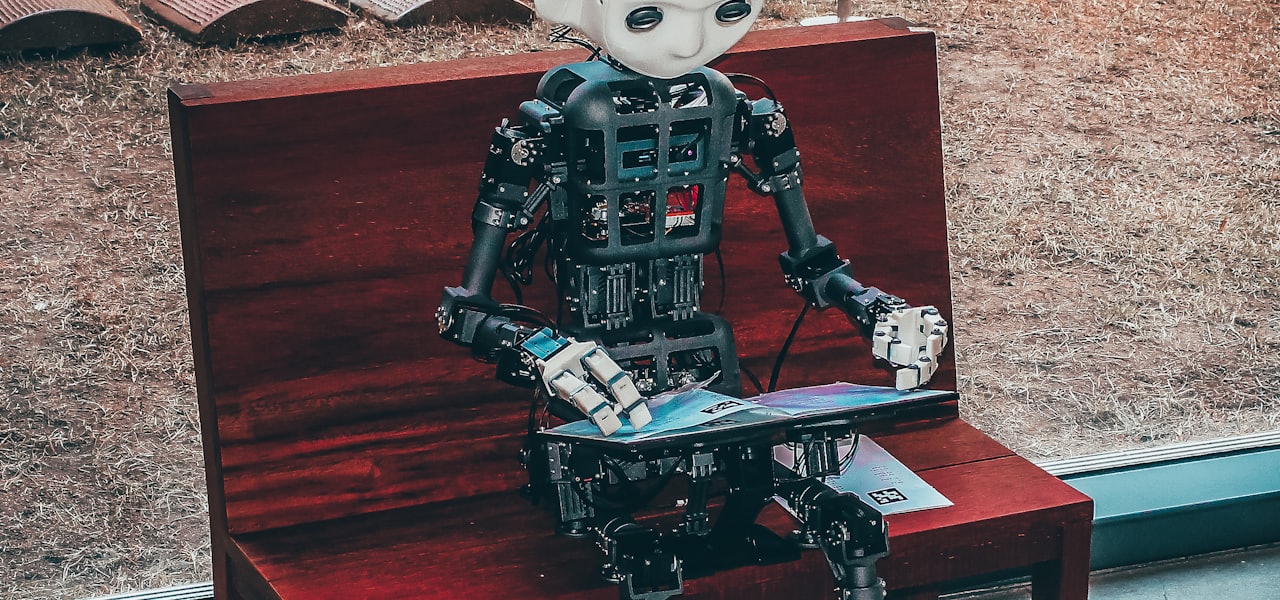
Negobot also referred to as Lolita or Lolita chatbot is a chatterbot that was introduced to the public in 2013, designed by researchers from the University of Deusto and Optenet to catch online pedophiles. It is a conversational agent that utilizes natural language processing (NLP), information retrieval (IR) and Automatic Learning. Because the bot poses as a young female in order to entice and track potential predators, it became known in media as the "virtual Lolita", in reference to Vladimir Nabokov's novel. == Background == In 2013, the University of Deusto researchers published a paper on their work with Negobot and disclosed the text online. In their abstract, the researchers addressed the issue that an increasing number of children are using the internet and that these young users are more susceptible to existing internet risks. Their main objective was to create a chatterbot with the ability to trap online predators that posed a threat to children. They intended to deploy the bot into sites frequented by predators such as social networks and chatrooms. The university researchers used information provided by anti-pedophilia activist organization Perverted-Justice, including examples of online encounters and conversations with sexual predators, to supplement the program's artificial intelligence system. == Features == === Programmed persona === The chatterbot takes the guise of a naive and vulnerable 14-year-old girl. The bot's programmers used methods of artificial intelligence and natural language processing to create a conversational agent fluent in typical teenage slang, misspellings, and knowledge of pop culture. Through these linguistic features, the bot is able to mimic the conversational style of young teenagers. It also features split personalities and seven different patterns of conversation. Negobot's primary creator, Dr. Carlos Laorden, expressed the significance of the bot's distinguishable style of communication, stating that normally, "chatbots tend to be very predictable. Their behavior and interest in a conversation are flat, which is a problem when attempting to detect untrustworthy targets like paedophiles." What makes Negobot different is its game theory feature, which makes it able to "maintain a much more realistic conversation." Apart from being able to imitate a stereotypical teenager, the program is also able to translate messages into different languages. === Game theory === Negobot's designers programmed it with the ability to treat conversations with potential predators as if it were a game, the objective being to collect as much information on the suspect as possible that could provide evidence of pedophilic characteristics and motives. The use of game theory shapes the decisions the bot makes and the overall direction of the conversation. The bot initiates its undercover operations by entering a chat as a passive participant, waiting to be chatted by a user. Once a user elicits conversation, the bot will frame the conversation in such a way that keeps the target engaged, extracting personal information and discouraging it from leaving the chat. The information is then recorded to be potentially sent to the police. If the target seems to lose interest, the bot attempts to make it feel guilty by expressing sentiments of loneliness and emotional need through strategic, formulated responses, ultimately prolonging interaction. In addition, the bot may provide fake information about itself in attempt to lure the target into physical meetings. === Limitations === Despite being able to carry out a realistic conversation, Negobot is still unable to detect linguistic subtleties in the messages of others, including sarcasm. == Controversy == John Carr, a specialist in online child safety, expressed his concern to BBC over the legality of this undercover investigation. He claimed that using the bot on unsuspecting internet users could be considered a form of entrapment or harassment. The type of information that Negobot collects from potential online predators, he said, is unlikely to be upheld in court. Furthermore, he warned that relying on only software without any real-world policing risks enticing individuals to do or say things that they would not have if real-world policing were a factor.
Shepp–Logan phantom
The Shepp–Logan phantom is a standard test image created by Larry Shepp and Benjamin F. Logan for their 1974 paper "The Fourier Reconstruction of a Head Section". It serves as the model of a human head in the development and testing of image reconstruction algorithms. == Definition == The function describing the phantom is defined as the sum of 10 ellipses inside a 2×2 square:
Collateral freedom
Collateral freedom is an anti-censorship strategy that attempts to make it economically prohibitive for censors to block content on the Internet. This is achieved by hosting content on cloud services that are considered by censors to be "too important to block", and then using encryption to prevent censors from identifying requests for censored information that is hosted among other content, forcing censors to either allow access to the censored information or take down entire services.
Online service provider
An online service provider (OSP) can, for example, be an Internet service provider, an email provider, a news provider (press), an entertainment provider (music, movies), a search engine, an e-commerce site, an online banking site, a health site, an official government site, social media, a wiki, or a Usenet newsgroup. In its original more limited definition, it referred only to a commercial computer communication service in which paid members could dial via a computer modem the service's private computer network and access various services and information resources such as bulletin board systems, downloadable files and programs, news articles, chat rooms, and electronic mail services. The term "online service" was also used in references to these dial-up services. The traditional dial-up online service differed from the modern Internet service provider in that they provided a large degree of content that was only accessible by those who subscribed to the online service, while ISP mostly serves to provide access to the Internet and generally provides little if any exclusive content of its own. In the U.S., the Online Copyright Infringement Liability Limitation Act (OCILLA) portion of the U.S. Digital Millennium Copyright Act has expanded the legal definition of online service in two different ways for different portions of the law. It states in section 512(k)(1): (A) As used in subsection (a), the term "service provider" means an entity offering the transmission, routing, or providing of connections for digital online communications, between or among points specified by a user, of material of the user's choosing, without modification to the content of the material as sent or received. (B) As used in this section, other than subsection (a), the term "service provider" means a provider of online services or network access, or the operator of facilities therefore, and includes an entity described in subparagraph (A). These broad definitions make it possible for numerous web businesses to benefit from the OCILLA. == History == The first commercial online services went live in 1969. CompuServe (owned in the 1980s and 1990s by H&R Block) and The Source (for a time owned by The Reader's Digest) are considered the first major online services created to serve the market of personal computer users. Utilizing text-based interfaces and menus, these services allowed anyone with a modem and communications software to use email, chat, news, financial and stock information, bulletin boards, special interest groups (SIGs), forums and general information. Subscribers could exchange email only with other subscribers of the same service. (For a time a service called DASnet carried mail among several online services, and CompuServe, MCI Mail, and other services experimented with X.400 protocols to exchange email until the Internet rendered these outmoded.) Other text-based online services followed such as Delphi, GEnie and MCI Mail. The 1980s also saw the rise of independent Computer Bulletin Boards, or BBSes. (Online services are not BBSes. An online service may contain an electronic bulletin board, but the term "BBS" is reserved for independent dialup, microcomputer-based services that are usually single-user systems.) The commercial services used pre-existing packet-switched (X.25) data communications networks, or the services' own networks (as with CompuServe). In either case, users dialed into local access points and were connected to remote computer centers where information and services were located. As with telephone service, subscribers paid by the minute, with separate day-time and evening/weekend rates. As the use of computers that supported color and graphics, such the Atari 8-bit computers, Commodore 64, TI-99/4A, Apple II, and early IBM PC compatibles, increased, online services gradually developed framed or partially graphical information displays. Early services such as CompuServe added increasingly sophisticated graphics-based front end software to present their information, though they continued to offer text-based access for those who needed or preferred it. In 1985 Viewtron, which began as a Videotex service requiring a dedicated terminal, introduced software allowing home computer owners access. Beginning in the mid-1980s graphics based online services such as PlayNET, Prodigy, and Quantum Link (aka Q-Link) were developed. Quantum Link, which was based on Commodore-only Playnet software, later developed AppleLink Personal Edition, PC-Link (based on Tandy's DeskMate), and Promenade (for IBM), all of which (including Q-Link) were later combined as America Online. These online services presaged the web browser that would change global online life 10 years later. Before Quantum Link, Apple computer had developed its own service, called AppleLink, which was mostly a support network targeted at Apple dealers and developers. Later, Apple offered the short-lived eWorld, targeted at Mac consumers and based on the Mac version of the America Online software. Beginning in 1992, the Internet, which had previously been limited to government, academic, and corporate research settings, was opened to commercial entities. The first online service to offer Internet access was DELPHI, which had developed TCP/IP access much earlier, in connection with an environmental group that rated Internet access. The explosion of popularity of the World Wide Web in 1994 accelerated the development of the Internet as an information and communication resource for consumers and businesses. The sudden availability of low- to no-cost email and appearance of free independent web sites broke the business model that had supported the rise of the early online service industry. CompuServe, BIX, AOL, DELPHI, and Prodigy gradually added access to Internet e-mail, Usenet newsgroups, ftp, and to web sites. At the same time, they moved from usage-based billing to monthly subscriptions. Similarly, companies that paid to have AOL host their information or early online stores began to develop their own web sites, putting further stress on the economics of the online industry. Only the largest services like AOL (which later acquired CompuServe, just as CompuServe acquired The Source) were able to make the transition to the Internet-centric world. A new class of online service provider arose to provide access to the Internet, the internet service provider or ISP. Internet-only service providers like UUNET, The Pipeline, Panix, Netcom, the World, EarthLink, and MindSpring provided no content of their own, concentrating their efforts on making it easy for nontechnical users to install the various software required to "get online" before consumer operating systems came internet-enabled out of the box. In contrast to the online services' multitiered per-minute or per-hour rates, many ISPs offered flat-fee, unlimited access plans. Independent companies sprang up to offer access and packages to compete with the big networks (eg, the-wire.com, 1994 in Toronto and bway.net 1995 in New York). These providers first offered access through telephone and modem, just as did the early online services providers. By the early 2000s, these independent ISPs had largely been supplanted by high speed and broadband access through cable and phone companies, as well as wireless access. The importance of the online services industry was vital in "paving the road" for the information superhighway. When Mosaic and Netscape were released in 1994, they had a ready audience of more than 10 million people who were able to download their first web browser through an online service. Though ISPs quickly began offering software packages with setup to their customers, this brief period gave many users their first online experience. Two online services in particular, Prodigy and AOL, are often confused with the Internet, or the origins of the Internet. Prodigy's Chief Technical Officer said in 1999: "Eleven years ago, the Internet was just an intangible dream that Prodigy brought to life. Now it is a force to be reckoned with." Despite that statement, neither service provided the back bone for the Internet, nor did either start the Internet. == Online service interfaces == The first online service used a simple text-based interface in which content was largely text only and users made choices via a command prompt. This allowed just about any computer with a modem and terminal communications program the ability to access these text-based online services. CompuServe would later offer, with the advent of the Apple Macintosh and Microsoft Windows-based PCs, a GUI interface program for their service. This provided a very rudimentary GUI interface. CompuServe continued to offer text-only access for those needing it. Online services like Prodigy and AOL developed their online service around a GUI and thus unlike CompuServe's early GUI-based software, these online services provided a more robust GUI interface. Early GUI-base
Gonioreflectometer
A gonioreflectometer is a device for measuring a bidirectional reflectance distribution function (BRDF). The device consists of a light source illuminating the material to be measured and a sensor that captures light reflected from that material. The light source should be able to illuminate and the sensor should be able to capture data from a hemisphere around the target. The hemispherical rotation dimensions of the sensor and light source are the four dimensions of the BRDF. The 'gonio' part of the word refers to the device's ability to measure at different angles. Several similar devices have been built and used to capture data for similar functions. Most of these devices use a camera instead of the light intensity-measuring sensor to capture a two-dimensional sample of the target. Examples include: a spatial gonioreflectometer for capturing the SBRDF (McAllister, 2002). a camera gantry for capturing the light field (Levoy and Hanrahan, 1996). an unnamed device for capturing the bidirectional texture function (Dana et al., 1999).
Case-based reasoning
Case-based reasoning (CBR), broadly construed, is the process of solving new problems based on the solutions of similar past problems. In everyday life, an auto mechanic who fixes an engine by recalling another car that exhibited similar symptoms is using case-based reasoning. A lawyer who advocates a particular outcome in a trial based on legal precedents or a judge who creates case law is using case-based reasoning. So, too, an engineer copying working elements of nature (practicing biomimicry) is treating nature as a database of solutions to problems. Case-based reasoning is a prominent type of analogy solution making. It has been argued that case-based reasoning is not only a powerful method for computer reasoning, but also a pervasive behavior in everyday human problem solving; or, more radically, that all reasoning is based on past cases personally experienced. This view is related to prototype theory, which is most deeply explored in cognitive science. == Process == Case-based reasoning has been formalized for purposes of computer reasoning as a four-step process: Retrieve: Given a target problem, retrieve cases relevant to solving it from memory. A case consists of a problem, its solution, and, typically, annotations about how the solution was derived. For example, suppose Fred wants to prepare blueberry pancakes. Being a novice cook, the most relevant experience he can recall is one in which he successfully made plain pancakes. The procedure he followed for making the plain pancakes, together with justifications for decisions made along the way, constitutes Fred's retrieved case. Reuse: Map the solution from the previous case to the target problem. This may involve adapting the solution as needed to fit the new situation. In the pancake example, Fred must adapt his retrieved solution to include the addition of blueberries. Revise: Having mapped the previous solution to the target situation, test the new solution in the real world (or a simulation) and, if necessary, revise. Suppose Fred adapted his pancake solution by adding blueberries to the batter. After mixing, he discovers that the batter has turned blue – an undesired effect. This suggests the following revision: delay the addition of blueberries until after the batter has been ladled into the pan. Retain: After the solution has been successfully adapted to the target problem, store the resulting experience as a new case in memory. Fred, accordingly, records his new-found procedure for making blueberry pancakes, thereby enriching his set of stored experiences, and better preparing him for future pancake-making demands. == Comparison to other methods == At first glance, CBR may seem similar to the rule induction algorithms of machine learning. Like a rule-induction algorithm, CBR starts with a set of cases or training examples; it forms generalizations of these examples, albeit implicit ones, by identifying commonalities between a retrieved case and the target problem. If for instance a procedure for plain pancakes is mapped to blueberry pancakes, a decision is made to use the same basic batter and frying method, thus implicitly generalizing the set of situations under which the batter and frying method can be used. The key difference, however, between the implicit generalization in CBR and the generalization in rule induction lies in when the generalization is made. A rule-induction algorithm draws its generalizations from a set of training examples before the target problem is even known; that is, it performs eager generalization. For instance, if a rule-induction algorithm were given recipes for plain pancakes, Dutch apple pancakes, and banana pancakes as its training examples, it would have to derive, at training time, a set of general rules for making all types of pancakes. It would not be until testing time that it would be given, say, the task of cooking blueberry pancakes. The difficulty for the rule-induction algorithm is in anticipating the different directions in which it should attempt to generalize its training examples. This is in contrast to CBR, which delays (implicit) generalization of its cases until testing time – a strategy of lazy generalization. In the pancake example, CBR has already been given the target problem of cooking blueberry pancakes; thus it can generalize its cases exactly as needed to cover this situation. CBR therefore tends to be a good approach for rich, complex domains in which there are myriad ways to generalize a case. In law, there is often explicit delegation of CBR to courts, recognizing the limits of rule based reasons: limiting delay, limited knowledge of future context, limit of negotiated agreement, etc. While CBR in law and cognitively inspired CBR have long been associated, the former is more clearly an interpolation of rule based reasoning, and judgment, while the latter is more closely tied to recall and process adaptation. The difference is clear in their attitude toward error and appellate review. Another name for case-based reasoning in problem solving is symptomatic strategies. It does require à priori domain knowledge that is gleaned from past experience which established connections between symptoms and causes. This knowledge is referred to as shallow, compiled, evidential, history-based as well as case-based knowledge. This is the strategy most associated with diagnosis by experts. Diagnosis of a problem transpires as a rapid recognition process in which symptoms evoke appropriate situation categories. An expert knows the cause by virtue of having previously encountered similar cases. Case-based reasoning is the most powerful strategy, and that used most commonly. However, the strategy won't work independently with truly novel problems, or where deeper understanding of whatever is taking place is sought. An alternative approach to problem solving is the topographic strategy which falls into the category of deep reasoning. With deep reasoning, in-depth knowledge of a system is used. Topography in this context means a description or an analysis of a structured entity, showing the relations among its elements. Also known as reasoning from first principles, deep reasoning is applied to novel faults when experience-based approaches aren't viable. The topographic strategy is therefore linked to à priori domain knowledge that is developed from a more a fundamental understanding of a system, possibly using first-principles knowledge. Such knowledge is referred to as deep, causal or model-based knowledge. Hoc and Carlier noted that symptomatic approaches may need to be supported by topographic approaches because symptoms can be defined in diverse terms. The converse is also true – shallow reasoning can be used abductively to generate causal hypotheses, and deductively to evaluate those hypotheses, in a topographical search. == Criticism == Critics of CBR argue that it is an approach that accepts anecdotal evidence as its main operating principle. Without statistically relevant data for backing and implicit generalization, there is no guarantee that the generalization is correct. However, all inductive reasoning where data is too scarce for statistical relevance is inherently based on anecdotal evidence. == History == CBR traces its roots to the work of Roger Schank and his students at Yale University in the early 1980s. Schank's model of dynamic memory was the basis for the earliest CBR systems: Janet Kolodner's CYRUS and Michael Lebowitz's IPP. Other schools of CBR and closely allied fields emerged in the 1980s, which directed at topics such as legal reasoning, memory-based reasoning (a way of reasoning from examples on massively parallel machines), and combinations of CBR with other reasoning methods. In the 1990s, interest in CBR grew internationally, as evidenced by the establishment of an International Conference on Case-Based Reasoning in 1995, as well as European, German, British, Italian, and other CBR workshops. CBR technology has resulted in the deployment of a number of successful systems, the earliest being Lockheed's CLAVIER, a system for laying out composite parts to be baked in an industrial convection oven. CBR has been used extensively in applications such as the Compaq SMART system and has found a major application area in the health sciences, as well as in structural safety management. There is recent work that develops CBR within a statistical framework and formalizes case-based inference as a specific type of probabilistic inference. Thus, it becomes possible to produce case-based predictions equipped with a certain level of confidence. One description of the difference between CBR and induction from instances is that statistical inference aims to find what tends to make cases similar while CBR aims to encode what suffices to claim similarly.
MovieRide FX
MovieRide FX is a patented automated special visual effects video compositing engine used in the MovieRide FX mobile application for Android (requires Android 2.3 or later) and iOS (compatible with iPhone 4 and up, iPad, and iPod Touch (new generation), requires iOS 7 or later). MovieRide FX allows the user to personalize a "Hollywood-style" movie clip by inserting themself into the clip as the "actor". == Features == The MovieRide FX app uses the relevant mobile device's camera to record a video of the user and insert it into a pre-packaged "Hollywood style" movie clip. The "actor" is extracted from their recorded video clip through various known effects such as masking, keying, and motion tracking. The "actor" is then inserted into one of the pre-packaged movie clips created by the MovieRide FX visual effects artists. This is done through an automated process requiring little or no artistic or technical skill from the user. The custom movie clips pre-packaged with MovieRide FX offer the user a variety of movie scenarios. Additional clips based on popular television and movie themes are continually being developed and are available on a freemium basis. == Sharing == Once the user's footage has automatically been composited into a movie clip and rendered as an .mp4 file, it can be shared via social media, such as Facebook, YouTube, and Twitter, and by e-mail. == History == === 2012 === MovieRide FX was created by Grant Waterston and Johann Mynhardt, who started development in 2012. === 2013 === The beta version was released on Google Play in July 2013. In August 2013 MovieRide FX was a New Media Award winner in the "New Media" category of the Accolade International Awards in Los Angeles. In October 2013 MovieRide FX was awarded exhibitor space in the ‘start-up village’ at the Apps-World Expo in London. === 2014 === MovieRide FX reached the 100 000 – 500 000 downloads category on the Google Play Store in June 2014. The official Android version was launched in July 2014. iOS version released in August 2014. MovieRide FX was selected as one of the "Top 150" startups at the Pioneer Festival in Vienna in September 2014. In November 2014 MovieRide FX was shortlisted for the Appster Awards in the "Best Entertainment App" and "Most Innovative App" categories and was awarded exhibitor space at the ‘start-up village’ at the Apps-World Expo in London. Patent applications were filed in South Africa, the EU and USA in April 2014. === 2015 === In September 2015 MovieRide FX was shortlisted for "Best Software innovation" at The Technology Expo Awards in London. === 2016 === In April 2016 MovieRide FX was nominated for a National Science and Technology Forum (NSTF) award for 'Research leading to Innovation by a corporate organization' In August 2016 Movie Ride FX won two Gold Awards at the 2016 Mobile Marketing Awards (MMA Smarties SA). These two Gold awards were for the 'Innovation' and 'Best in Show’ categories. In December 2016 FlicJam Inc. was formed in the US to access the larger global market. EU patent application was published in March 2016. === 2017 === South African patent was granted in February 2017. === 2018 === US patent was granted in March 2018.